Category: Uncategorized

  • Maynard Jackson Netflix Movie Muddles Black Politics, Mangles Black History

    For a politician’s biography, the Sam Pollard documentary currently available on Netflix, which recounts the life and career of Maynard Jackson, the first of Atlanta’s six consecutive black mayors, is remarkably free of politics. But when you think about it, this should not be a surprise.

    After all, politics in any and every historical era is how we humans address our collective affairs. Politics is how we struggle to determine who produces what for whom, and under which conditions. Politics is how we decide which groups of people get to access the resources and the wealth that the planet provides and which its people produce, and which groups see their needs ignored. It makes perfect sense then, for elites to protect themselves by constructing fake histories which portray their own triumphs as virtuous and inevitable, histories which minimize or deny the very existence of struggles from below conducted by and for the masses of people who actually produce the wealth which elites mostly take for themselves, histories stripped clean of inconvenient politics.

    The Pollard film walks us through Jackson’s illustrious family history, the grandson on his mother’s side, of John Wesley Dobbs, an influential college educated postal employee and Prince Hall Masonic Grand Master who prescribed “bucks, ballots and books ” as the keys to black uplift.

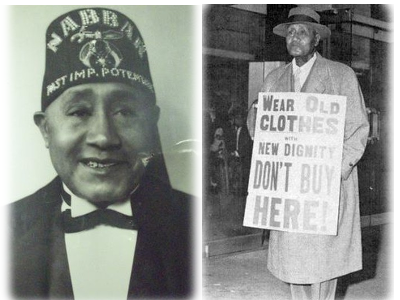
    John Wesley Dobbs, Maynard Jackson's maternal grandfather
    John Wesley Dobbs, Maynard Jackson’s maternal grandfather.

    Dobbs was a key player in registering tens of thousands of black Atlanta voters in the 1940s, a time when many rural black Georgians were either illiterate or not allowed to vote. His efforts were widely credited with getting the city of Atlanta to finally put street lights on Auburn Avenue, where many black businesses were located, and to hire the first handful of black Atlanta cops, who of course were not permitted to arrest white people. It’s not in the movie, but Billy McKinney , decades later a Georgia state representative, and the father of former Atlanta congressperson Cynthia McKinney was one of those first black Atlanta cops.

    Jackson’s dad was a prominent black Atlanta pastor and his mother was one of six Dobbs daughters all of whom graduated from Atlanta’s Spelman College , earning her PhD at the University of Toulouse in France. Upon her return to Atlanta she was the first black person granted a library card by the city’s public library. If there was such a thing as an African American elite, Maynard Jackson was born into it. An exceptionally smart young man, he was admitted to Morehouse at 14, graduated at 18, and bounced around a little before obtaining a law degree in North Carolina. According to the movie, it seems Maynard Jackson never much considered a career doing anything else other than running for and winning elected office.

    In 1968 Maynard Jackson ran for US Senate against arch-segregationist senator Herman Talmadge, who’d inherited a political career from his daddy, three term governor Eugene Talmadge . Jackson lost, but thanks to the black vote he did carry the city of Atlanta. The following year he was elected Atlanta’s vice-mayor, and four years later at the age of 35 he became the first black mayor of Atlanta.

    The movie dwells nostalgically upon the star studded celebration

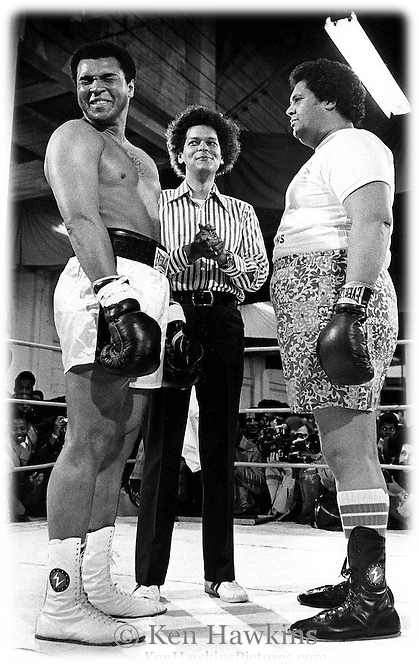
    Jackson spars with Muhammad Ali for charity
    Maynard Jackson spars with Muhammad Ali for charity.

    which attended his ascension to mayoral office, and contemptuously dismisses the aspirations of the black masses who voted for Jackson and his successors, saying they somehow expected the election of black mayors to solve all their problems. Pollard spends the biggest chunk of the movie following the ins and outs of Jackson’s struggles, in his three terms as mayor, with Atlanta’s white elite to put black faces on the boards of banks and planning bodies, and his adamant insistence that black companies be cut a fair share of city contracts and professional services. It’s quite clear that for the film makers, for Jackson’s contemporaries who they interviewed, and for Maynard Jackson himself, that the project of diversifying and opening up the capitalist elite was then and remains today the main objective of black politics, not the struggles of ordinary people for jobs, decent wages, housing, health care, education, justice and peace.

    The movie goes so far as to portray the effort of Maynard Jackson and former mayor Andrew Young in which they shamelessly invoked the ghost of Dr. Martin Luther King to bring the 1996 Olympics to Atlanta as some kind of visionary achievement that really put the city on the map, whatever that term means. In real life, as lived by most residents of cities which “win” the right to host the Olympic Games, the prize consists of an orgy of predatory real estate speculation in which entire low to moderate income neighborhoods are demolished to make way for stadiums, luxury hotel and tourist destinations, for upscale shopping and residential development, all of it lavishly subsidized with tax dollars taken from property taxes and wages of the poor, not from the wealth of the rich. Atlanta was no exception to this rule. Neighborhoods surrounding the Olympic sacrifice zone experienced precipitous increases in real estate taxes and rents to levels which Atlanta residents who were there before the Olympics could not sustain. The lion’s share of the displaced Atlanta homeowners and renters were of course black. But their struggles, their politics have no place in the self-serving histories written by the black elite, so the movie just doesn’t see them.

    This political biography ignores the political struggles of ordinary Atlanta residents for decent housing, wages and working conditions, when they could get a job at all. It never mentions the decades long fights for universally accessible health care which resulted for a time, in a well funded health care system in Atlanta’s Fulton and Dekalb counties – the Grady Hospital system, parts of which endure to this day.

    atlanta sanitation workers strike 1977
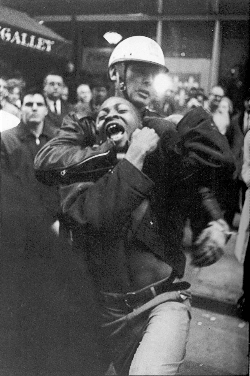
    Atlanta cops brutally assault striking
    sanitation workers during 1977 strike,

    Tellingly, it omits Maynard Jackson’s decisive and shameful intervention in the 1977 strike of Atlanta’s heinously abused and underpaid black sanitation workers, in which the first black mayor hired scabs and mobilized SCLC, black pastors and civil rights leaders against self-organizing black workers standing up for their human rights.

    The only person the film makers interviewed who wasn’t a family member, a successor, aide or associate of the late mayor or reverends named Al Sharpton or Jesse Jackson was a relative of one of the victims of Atlanta’s child murders during Jackson’s final term as mayor. To hear them tell it, that and the insurrection following the Rodney King verdict, and Jackson’s failure, typical of every other deeply change the institution of policing beyond hiring and promoting more black officers, were the only real failures of Jackson’s career.

    Sam Pollard’s kind of political history with most of the politics removed is the rancid foundational myth for the long running hoax of Atlanta as North America’s Black Mecca. Fact is, Black Mecca was never anything other than the self-promoting, self-serving and self-celebrating PR campaign of black elites. As I wrote back in 2005,

    Today’s elite black leadership does not measure cities by their incarceration rates , nor do they measure their own performance by the prevalence or absence of child poverty, affordable health care, equality of access to good education or any of the things that matter to ordinary black families. What matters to these “black leaders” are big-ticket projects, bragging rights, relentless self-promotion, and the accumulation of contacts, contracts and personal wealth. “Black Mecca” was always intended to be where their dreams came true, not ours.”

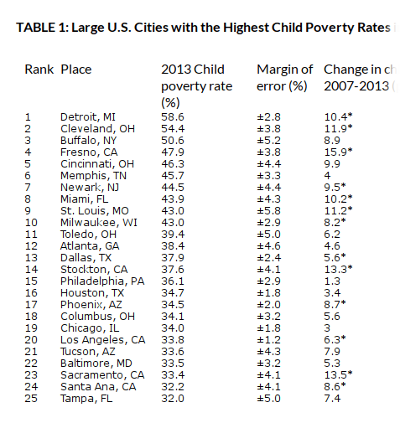
    For a generation now, Atlanta has been among the top four or five US cities for black millionaires. But 2013 census data plainly reveal that among the 71 US cities with populations over a quarter million

    child poverty by city
    Atlanta, the supposed “Black Mecca” ranks 12th in child
    poverty, better than Newark, Memphis or St Louis,
    but worse than Chicago, Los Angeles, Philly or
    Houston, according to US census data.

    Atlanta ranked 1 2th in child poverty with 38%, three of every eight children – you can bet they’re mostly black children – in households below the poverty line. That yardstick pegs Atlanta’s performance as a bit better than Cleveland, Newark, St. Louis or Milwaukee, but worse than Chicago, Los Angeles, Philly or Houston. But child poverty, let alone black child poverty is just NOT the the sort of measure of the learned scholars and practitioners employ to evaluate the efficacy of what passes for black politics.

    The accepted wisdom ignores these things, and the Sam Pollard documentary lazily slides right into that established groove. The film does get a couple of important things right. Jackson’s enduring political legacy was the cynical hoax of Atlanta as Black Mecca, and his career, which relied on the votes of black masses whose votes were mobilized behind the first black mayor who they imagined would deliver for their class instead of his own foretold the career arc of the first black president early in the 21st century.

    I’d give the thing two and a half stars out of five.

    For Black Agenda Radio, I’m Bruce Dixon. Please note that Google has limited public access to Black Agenda Report, suppressing the appearance of our material in search results for almost 3 years now, after the Washington Post endorsed a specious claim that we were somehow under the influence of the Russians. We are the first and as far as we know the only black owned and operated outfit to enjoy this distinction. Facebook’s recent partnership with the Atlantic Council puts deep state intelligence and propaganda operatives in charge of what you can and cannot see on Facebook as well. So the only way you can be certain you’re getting fresh news, commentary and analysis from the black left is to visit us at www.blackagendareport.com and hit the SUBSCRIBE button, so you’ll receive links to all our newly published print and audio content in your email inbox each and every week, free from the interference of the corporations which otherwise run the internet.

    The marketers call email “dark social media” because they cannot suppress, control, censor or track it. You can also find our audio podcasts – not our printed articles but our our weekly one hour Black Agenda Radio at iTunes, Stitcher and wherever else you get your podcasts, along with shorter Black Agenda Radio Commentaries like this one. If you catch us on iTunes or wherever you get podcasts be sure and leave us a glowing review, because that’s how other people discover us.

    We invite readers and listeners to respond to and comment on our articles and podcasts on Black Agenda Report’s Facebook page, or via email at comments@blackagendareport.com , that’s comments@blackagendareport.com . Some of the comments will appear and be answered in our new weekly letters column.

    Bruce A. Dixon is managing editor at Black Agenda Report, and a member of the state committee of the GA Green Party. He livesw and works near Marietta GA and can be reached via email at bruce.dixon(at)blackagendareport.com.

  • Hip Hop Forges Black and Native American Solidarity

    Kyle Mays, who teaches at the African American Studies Department and the Native American Center at UCLA, says Hip Hop “builds solidarity between the two communities,” which share a complex history of slavery, displacement and state violence. Mays is author of the book, Hip Hop Beats, Indigenous Rhymes: Modernity and Hip Hop in North America.Water rights and climate change are connected with larger political empowerment issues. “We need to somehow deal with the issue of returning land to native peoples,” said Mays, who is of Black and Native American ancestry.

    Originally published at Black Agenda Report on November 14, 2018.

  • US-Funded Neo-Nazis in Ukraine Mentor US White Supremacists

    Short-sighted U.S. foreign policy that backs jihadists in the Middle East and neo-Nazis in Ukraine is once again blowing back on the United States, as Max Blumenthal explains.

    FBI: Azov Battalion Trained Rise Above Movement

    By Max Blumenthal

    Last month, an unsealed FBI indictment of four American white supremacists from the Rise Above Movement (RAM) declared that the defendants had trained with Ukraine’s Azov Battalion, a neo-Nazi militia officially incorporated into the country’s national guard. The training took place after the white supremacist gang participated in violent riots in Huntington Beach and Berkeley, California and Charlottesville, Virginia in 2017.

    The indictment stated that the Azov Battalion “is believed to have participated in training and radicalizing United States-based white supremacy organizations.”

    After a wave of racist violence across America that culminated in the massacre of twelve Jewish worshippers at a Pittsburgh synagogue, the revelation that violent white supremacists have been traveling abroad for training and ideological indoctrination with a well-armed neo-Nazi militia should cause extreme alarm.

    Not only are white supremacists from across the West flocking to Ukraine to learn from the combat experience of their fascist brothers-in-arms, they are doing so openly — chronicling their experiences on social media before they bring their lessons back home. But U.S. law enforcement has done nothing so far to restrict the flow of right-wing American extremists to Azov’s bases.

    There is one likely explanation for the U.S. government’s hands-off approach to Azov recruitment: the extremist militia is fighting pro-Russian separatists as a front-line proxy of Washington. In fact, the United States has directly armed the Azov Battalion, forking over anti-tank rocket launchers and even sending a team of Army officers to meet in the field with Azov commanders in 2017.

    Though Congress passed legislation this year forbidding military aid to Azov on the grounds of its white supremacist ideology, the Trump administration’s authorization of $200 million in offensive weaponry and aid to the Ukrainian military makes it likely new stores of weapons will wind up the extremist regiment’s hands. When queried by reporters about evidence of American military training of Azov personnel, multiple U.S. army spokespersons admitted there was no mechanism in place to prevent that from happening.
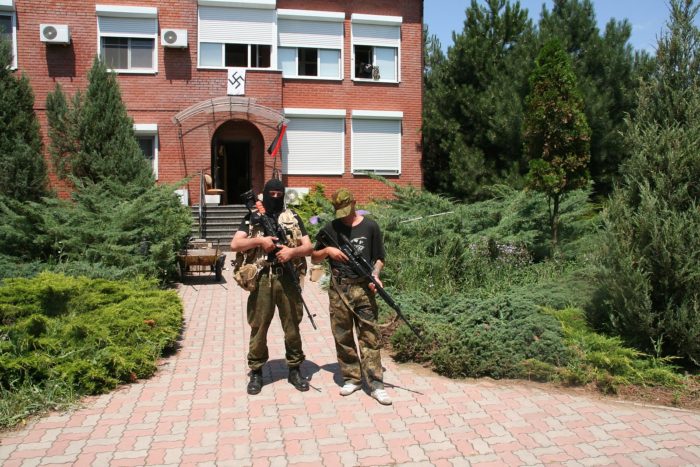
    Two soldiers from the Azov Battalion in front of a building with Nazi symbol at the battalion’s base in Urzuf. (Carl Ridderstråle-Wikimedia Commons)

    Today, Azov boasts combat experience, unlimited access to light weapons, and supporters honeycombed throughout the upper echelons of Ukraine’s military and government. No longer just a militia, the organization has developed into a political juggernaut that can overpower Ukraine’s government. Two years ago, the group flexed its muscle on the streets of Kiev, bringing out 10,000 supporters to demand that the government bend to their will or face a coup.

    “With its military experience and weapons, Azov has the ability to blackmail the government and defend themselves politically against any opposition. They openly say that if the government will not advance an ideology similar to theirs, they will overthrow it,” Ivan Katchanovski, a professor of political science at the University of Ottawa and leading expert on Ukraine’s far-right, commented to me. He continued, explaining:

    Currently the organizations that are fascist are stronger in Ukraine than in any other country in the world. But this fact is not reported by Western media because they see these organizations as supportive of the geopolitical agenda against Russia. So condemnations are limited to violence or human rights abuses.”

    The revelations of collaboration between violent American white supremacists and a neo-Nazi militia armed by the Pentagon add another scandalous chapter to a long history of blowback that dates back to the 1950’s, when the CIA rehabilitated several Ukrainian Nazi collaborators as anti-communist assets in the Cold War.

    The almost unbelievable story exposes an axis of fascism that stretches across the Atlantic, from the Ukrainian capital of Kiev to the sun-washed suburbs of Southern California, where some of the most rabid modern white supremacist gangs were born.

    White Nationalist Fight Club

    This October, four members of the RAM gang — Robert Rundo, Benjamin Drake Daley, Michael Paul Mirelis, and Aaron Eason — were arrested by FBI agents. They were accused of “using the internet to encourage, promote, participate in, and carry out riots” from Huntington Beach to Berkeley, California. Four other members had been arrested in connection with their participation in the white supremacist riot in Charlottesville, Virginia, where a counter-protester, Heather Heyer, was killed in a vehicular homicide by a white supremacist.

    RAM first appeared in the national limelight during a celebration of Donald Trump’s election victory in Huntington Beach in March 2017. As about one hundred far-right activists marched along the beach donned in red “Make America Great Again” caps and waving Trump flags, they were confronted by a small group of masked anti-racist counter-demonstrators. When a melee ensued, RAM members assaulted their outnumbered opponents, pummeling them into submission and even attacking a local reporter. Afterwards, Orange County police arrested several anti-racist demonstrators, but the RAM gang walked free.

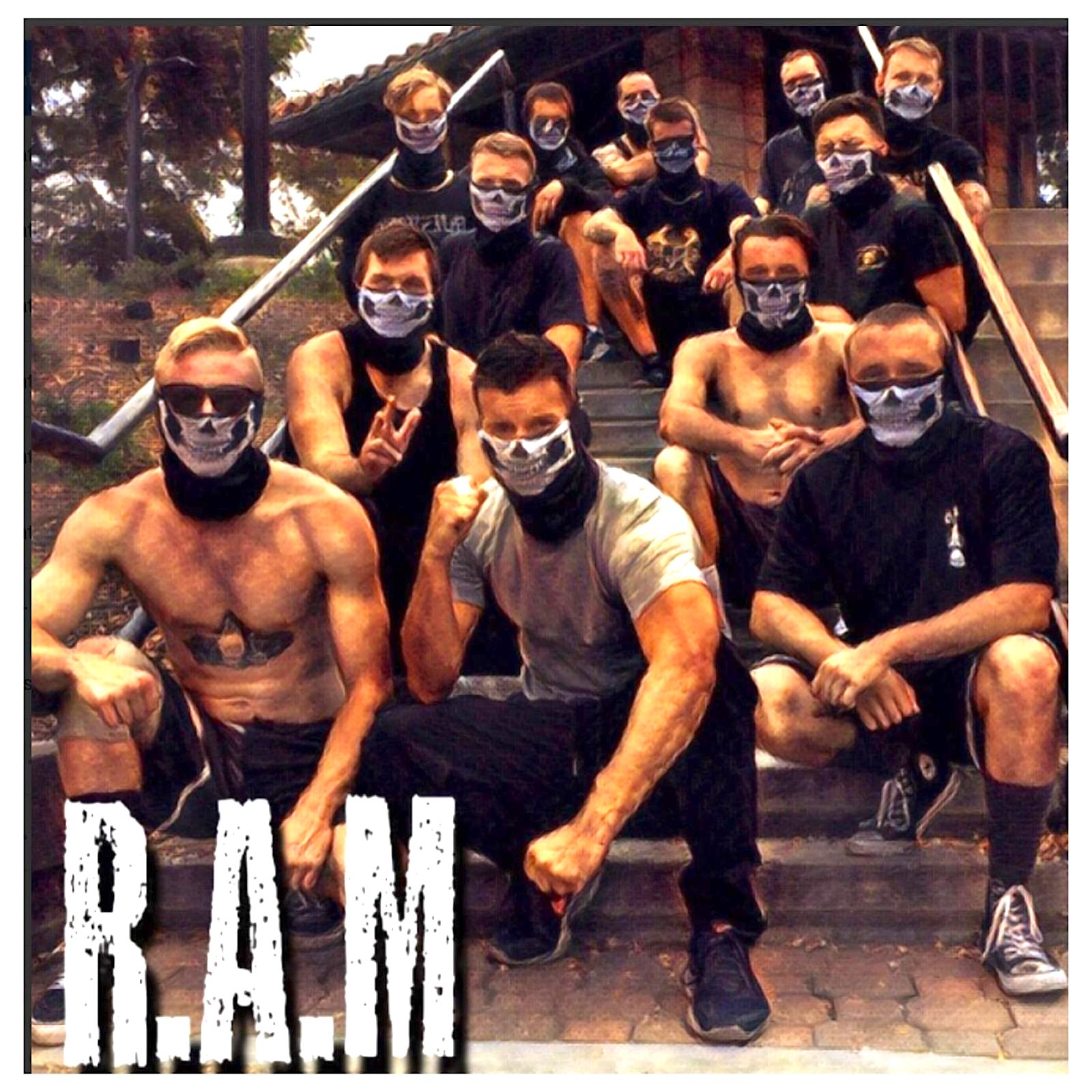
    RAM markets itself as a self-defense organization that protects the free speech of white Americans against an onslaught of “Cultural Marxism,”  a classic anti-Semitic trope. Its founders emphasize a vaguely anti-consumerist Fight Club mentality along with a rigorous dedication to mixed martial arts. Its co-founder, Rundo, operates an online clothing and apparel company, Right Brand Clothing, that hawks slickly designed t-shirts promoting “European Brotherhood,” stickers emphasizing a straight-edge “nationalist lifestyle,” and ethically sourced designer “Demagogue pants” (yes, white supremacists apparently care about sweatshops). RAM members can be seen at the site modeling their gear with a clean-cut “fashy” look that contrasts sharply with the stereotypical image of skinheads in jackboots.
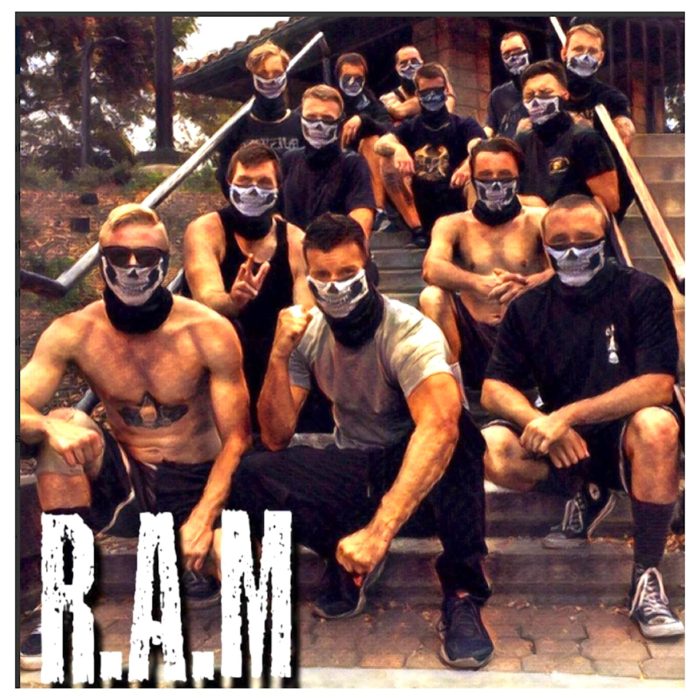
    RAM members from their now deleted Instagram account. (via ProPublica.)

    RAM’s careful attention to its public image has not stopped its members from putting their crude neo-Nazi ideology on display at rallies, however. During the Huntington Beach riot, for example, RAM’s Robert Boman was seen waving a sign reading “Da Goyim Know.” This alt-right slogan refers to the white nationalist understanding of the supposed Jewish plot to dominate the world.

    “I’m a big supporter of the Fourteen, I’ll say that,” RAM’s Rundo proclaimed into a camera in Huntington Beach. The gang leader was referring to the notorious 14-word slogan coined by convicted white supremacist terrorist David Lane, which has become a rallying cry for fascists across the globe: “We must secure the existence of our people and a future for white children.”

    Two months after the violence in Huntington Beach, two RAM members were photographed in the same spot dousing literature they dubbed as “Cultural Marxist” with lighter fluid and setting it ablaze. Among the volumes they torched were “The Diary of Anne Frank,” “The 9/11 Commission Report,” and “Schindler’s List.” Besides evoking memories of the early days of Nazi Germany, the spectacle cast the group’s purported devotion to free speech in an extremely ironic light.

    Following RAM’s highly publicized street battles, the group became the subject of intense media scrutiny. In October 2017, the investigative outlet ProPublica produced a video that exposed the identities of RAM’s core membership and wondered why they had not been investigated by law enforcement for their violent actions in Huntington Beach and elsewhere.

    But the media coverage of RAM glossed over the group’s attraction to a burgeoning trans-Atlantic conglomeration of white supremacists that centered on U.S.-allied Ukraine as the base for a fascist reconquest of Europe. By the Spring of 2018, RAM leadership was barnstorming through Germany and Italy and heading east to meet fascist cohorts from across the West at a conference in Kiev.

    RAM’s Ukrainian Hate-cation

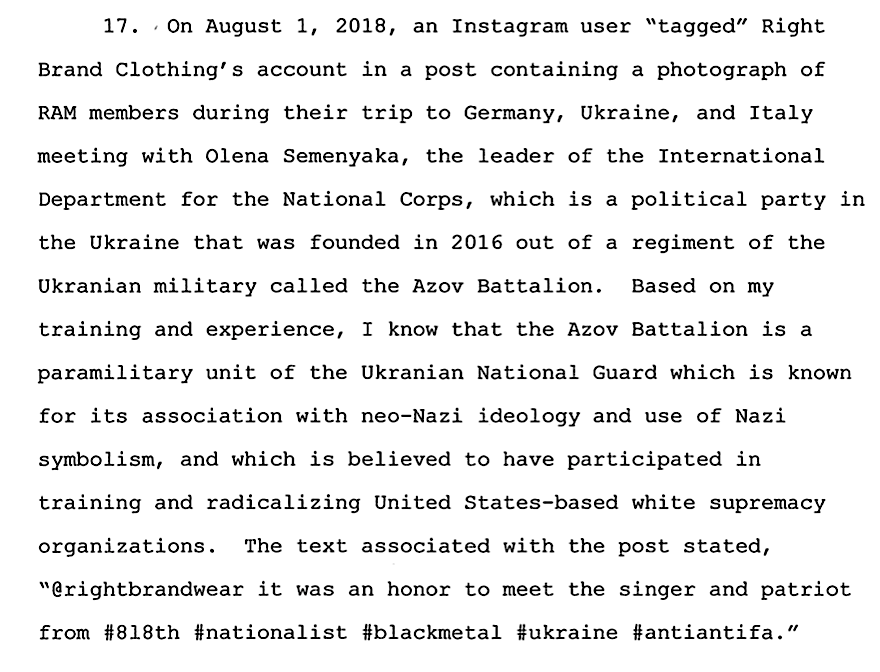
    Buried in the FBI indictment of RAM members are details of their meetings with one of the key figures in Ukraine’s neo-Nazi Azov Battalion militia.

    In August, according to the indictment, RAM members published photos on Instagram showing themselves meeting with Olena Semanyaka, the leader of the international department of the Ukrainian National Corps, which functions as a civilian arm of the Azov Battalion:
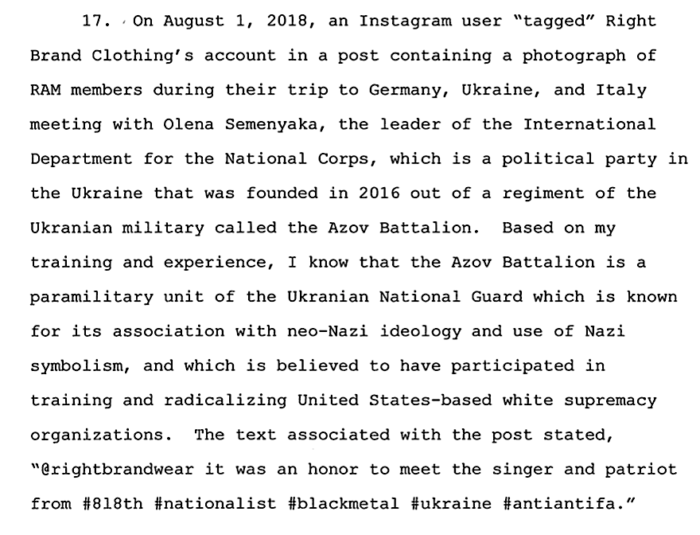
    The indictment also referenced a video of RAM co-founder Benjamin Drake Daley performing a crossed-forearm salute to the Southern California-based white supremacist Hammerskin gang while in Ukraine:
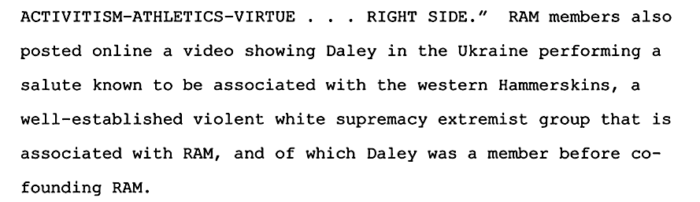
     

    RAM’s Gab account provides additional details of the group’s foray through Ukraine this May. The trip centered around the Paneuropa conference, an event that brings together fascists from across the West to encourage international collaboration. It is hosted at the Reconquista Club in Kiev, and included an a mixed martial arts competition.

    “One of our guys has had the honor to be the first American to compete in the pan european organization Reconquista in Ukraine!” RAM declared on its Gab account. “This was a great experience meeting nationalist[s] that came [sic] as far as Portugal and Switzerland to take part.”

    The visit, which followed on the heels of meetings with white supremacists in Germany and with Italy’s fascist CasaPound party, highlighted the centrality of Ukraine to international fascist organizing. Further, the Paneuropa conference, where fascists build connections across national borders, revealed the Azov Battalion as much more than a militia fighting for control of a sliver of contested territory in eastern Ukraine.

    Semanyaka did not respond to an interview request delivered through Facebook messenger; however, she told Radio Free Europe’s Christopher Miller that RAM “came to learn our ways” and showed interest in learning how to create youth forces in the way Azov has.

    Today, Azov leaders openly acknowledge that were it not for the U.S.-backed coup that unfolded in Kiev’s Maidan Square in 2014, their organization would never have developed into the powerhouse it is. As Semanyaka said this year, according to a summary:

    The Ukrainian nationalist movement would have never reached such a level of development unless the war with Russia had begun. For the first time since the Second World War, nationalist formations have managed to create their own military wings, the brightest example being the Azov regime of the National Guard of Ukraine.”

    Right-wing Maidan Revolution
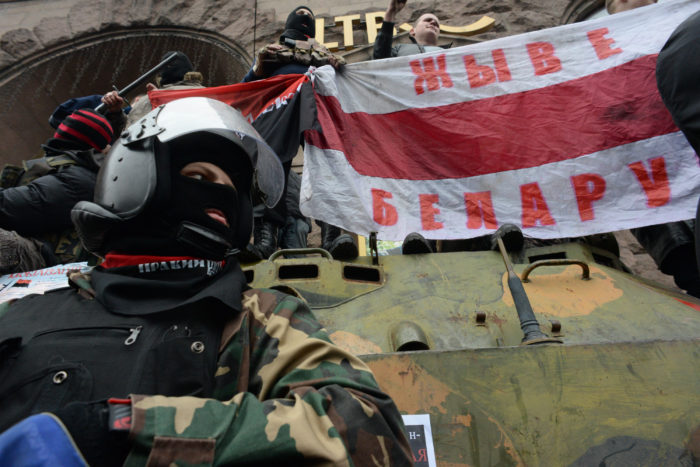
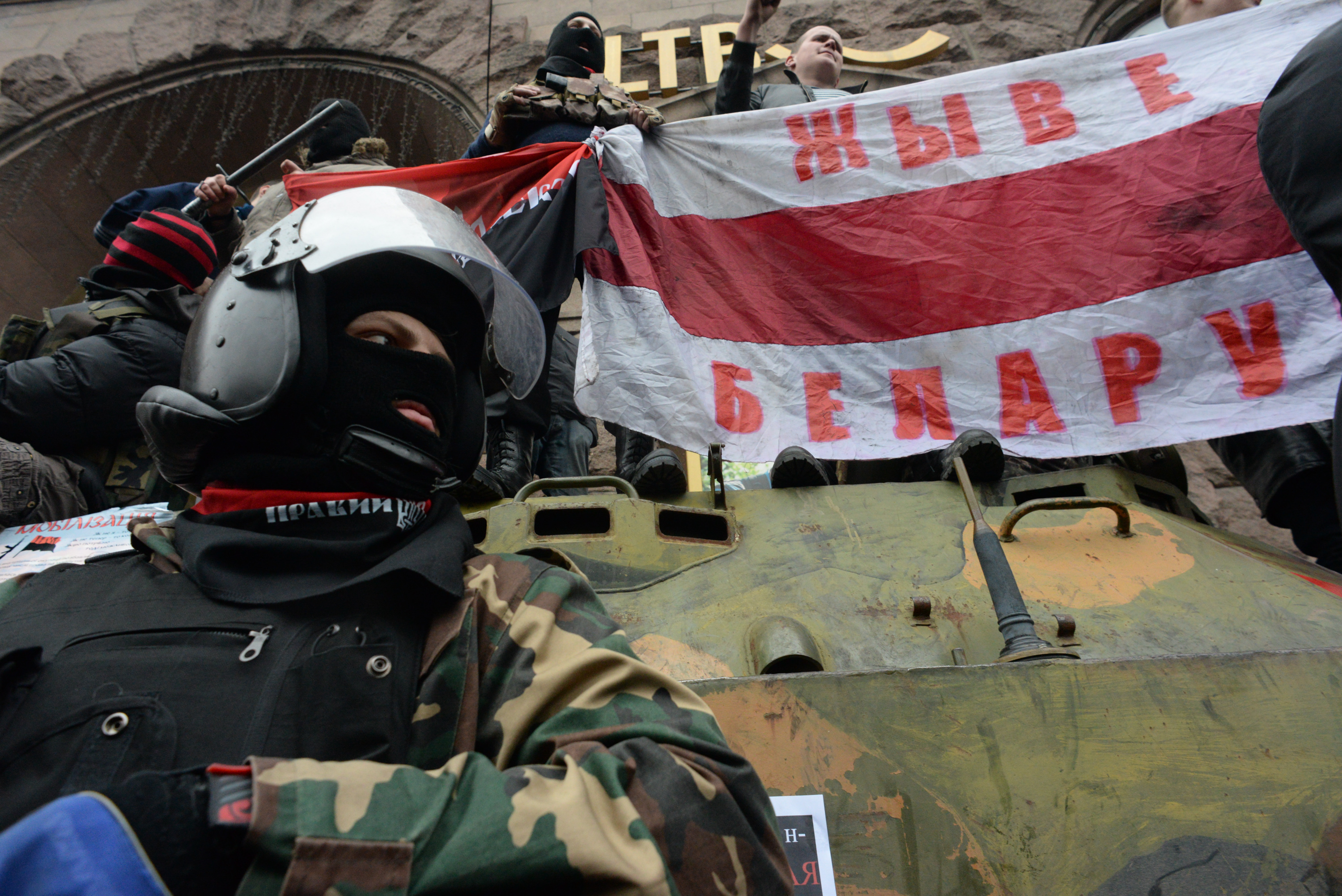
    Pravyi Sektor (Right Sector) extremists in Maidan, February 22, 2014. (Wikipedia)

    The 2013-14 Maidan revolt was the cataclysmic event that Ukraine’s already potent ultra-nationalist camp had been waiting for. The protests erupted in Kiev’s Maidan Square after the democratically elected President Viktor Yanukovych refused to sign an economic association agreement with the EU. Celebrated in the West as a pro-Western movement guided by tech-savvy middle-class youth, EuroMaidan depended heavily for its success on phalanxes of black-masked hardmen from Right Sector (see appendix at bottom), an ultra-nationalist party that did battle with the government’s Berkut riot police.

    Along with Right Sector, the leadership of the far-right Svoboda Party assumed a prominent role at the Maidan, dubbing the protests a “Revolution of Dignity.” Svoboda co-founder Oleh Tyahnybok — who had once demanded an investigation of the “Jewish-Muscovite mafia” that he saw controlling Ukraine — appeared on stage at the square beside U.S. Senators John McCain and Chris Murphy when they arrived to encourage the protesters.

    Another key figure in Ukraine’s neo-Nazi scene was Andriy Biletsky. A university Ph.D. who stressed physical violence as a means to revolutionary change, Biletsky led the Patriot of Ukraine militia, an early forerunner of Azov that attacked migrant camps and menaced foreigners. In a manifesto published during the height of the Maidan clashes, Biletsky outlined his post-revolutionary agenda: “The historic mission of our nation in this critical moment is to lead the White Races of the world in a final crusade for their survival,” he wrote. “A crusade against the Semite-led Untermenschen.”

    In May 2014, Right Sector and an assortment of far-right forces banded together to massacre their opponents in Odessa, attacking a pro-separatist protest camp with iron pipes then burning the fleeing protesters alive after they took shelter in a local trade union building. Over 40 pro-separatist Ukrainian citizens were consumed in the flames. The U.S. and EU studiously looked the other way, legitimizing the violence and setting the stage for more.

    Behind the scenes, U.S. Assistant Secretary of State Victoria Nuland and Ambassador Geoffrey Pyatt were carefully stage managing the opposition, positioning the pliable Arseniy Yatsenyuk as the future leader of a U.S. client-state. Meanwhile, billionaire-backed U.S. soft-power entities like the Omidyar Network and Open Society Foundation plowed money into the opposition, providing it with high-tech organizing capacity and establishing new media outlet Hromadske overnight.

    Given the amount of U.S. investment in regime change in Ukraine, it was necessary for American pundits who cheered on the operation to downplay or simply deny the central role neo-Nazi forces played in making it all possible. In perhaps the most absurd attempt at whitewashing the fascist presence, the neoconservative pundit James Kirchick described Right Sector in an article for Foreign Affairs as “Putin’s imaginary Nazis.” Meanwhile, groups like the Anti-Defamation League — which supposedly exist to battle anti-Semitism — refused to support a congressional effort to ban arms to groups affiliated with Right Sector, because “the focus should be on Russia.”

    With all the cover he needed from Washington, Biletsky organized the “imaginary Nazis” of Patriot of Ukraine, Right Sector, and assorted football ultras into a real militia called the Azov Battalion. Together, they fought under the neo-Nazi Wolfsangel symbol, which also happens to be incorporated into the logo of the U.S.-based Aryan Nations.
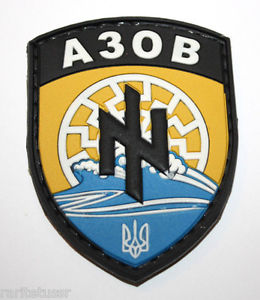
    Azov logo.

    On the frontlines of eastern Ukrainian flashpoints, Azov did battle with Russian-speaking separatists and set up government-sponsored indoctrination camps for children and teens closer to the country’s interior, instructing ten year olds on marksmanship and the evils of foreigners. Azan was subsequently absorbed into Ukraine’s military as a national guard unit, and began appearing in the field with PSRL-1 rocket launchers supplied under the watch of the U.S. Department of Defense. In November 2017, Azov leadership received a team of U.S. Army officers for training and logistical discussions (see photo below and to the right).

    By the time Congress approved a ban on arms to Azov this year, the Trump administration had already authorized a new shipment of offensive weapons to the Ukrainian military, including advanced Javelin anti-tank missiles. As in Syria — where the CIA-backed Free Syrian Army functioned as a de facto “weapons farm” for jihadist groups, including Jabhat al-Nusra and ISIS — any new U.S. arms are likely to wind up in the possession of Azov, the congressional ban notwithstanding.

    Arayan Nations logo.

    “It’s very corrupt in Ukraine and money can be stolen — the same as in Syria where extremist fighters got guns from U.S.-backed units,” said Katchanovski. “Azov can just establish new political fronts so they can circumvent the U.S. prohibitions.”

    Foreign Fighters for Fascism

    The Azov Battalion has received not only U.S. weapons, but also volunteer American military veterans like Brian Boyenger. “It’s not illegal,” Boyenger told a Ukraine Today interviewer of his presence in an Azov camp. “From a U.S. perspective, as long as you’re not fighting with a terrorist group or committing war crimes or things like that. It is legal — mostly I’ve been serving as kind of like an advisor.”

    Azov has also welcomed Islamist fighters from Chechnya to continue their long war against Russia in a new theater. A sniper from Sweden with “typical neo-Nazi views,” Mikael Skillt, has been assigned to oversee an entire Azov regiment. And neo-Nazis from as far away as Brazil have flocked to Ukraine to join the fascist crusade. One foreign fighter from France, a young anti-Semite named Gregoire Moutaux, returned from a Ukrainian militia camp in 2016 “armed to the teeth and ready to strike” synagogues, mosques and the 2016 soccer championships when he was arrested on the Ukrainian border by national police.

    To consolidate its political influence over the country, the Azov Battalion established a National Druzhina, or street patrol unit. A slickly produced recruitment video released in 2017 featured drone footage of National Druzhina members marching in formation into Kiev as Biletsky, their ideological guide, impelled them to “restore Ukrainian order” to a corrupted society. The street patrol was openly backed by Interior Minister Arsen Avakov, a powerful patron of Azov who belongs to the ruling party of Ukrainian President Petro Poroshenko.

    This year, the National Druzhina and state-funded neo-Nazi militias like C14 (the “14” represents the notorious “fourteen words” mantra) staged a series of lethal pogroms against the local Roma population, vandalized the offices of insufficiently pliant politicians, stormed city council meetings, and even sued the Hromadske station that was established with U.S. funding for describing their members as neo-Nazis.

    “Their connection to power is why they can commit any crime and they will never be punished,” Katchanovski said of Azov and its various street-muscle brigades. “Because they have the police and senior police members like [Vadym] Troyan, they can intimidate people and intimidate politicians with impunity.” (Once a member of Azov, Troyan now serves as Ukraine’s Deputy Minister of Interior).

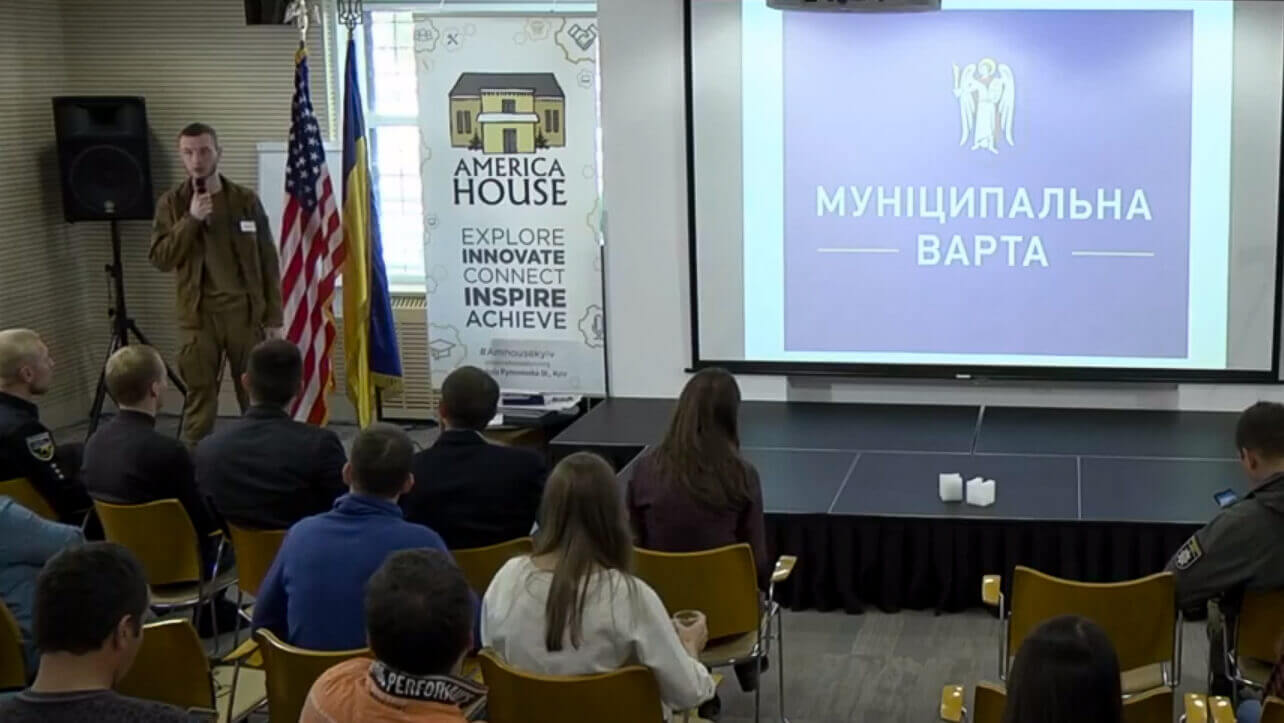
    Serhiy Bondar, a member of Ukraine’s neo-Nazi C14 militia, is hosted by the U.S.-funded America House in Kiev.  (YouTube)

    The U.S. has not only kept silent about the wave of ultra-nationalist violence sweeping across Ukraine, it has been complicit in legitimizing the perpetrators. This November, America House Kyiv — a U.S. government-funded cultural center — hosted a speech by a uniformed leader of the neo-Nazi C14 gang, Serhiy Bondar. Months earlier, Republican House Majority Leader Paul Ryan and the NATO-funded Atlantic Council hosted Andriy Parubiy, the speaker of the Ukrainian parliament and co-founder of the fascist Social-National party, for a friendly exchange on Capitol Hill.Given the free rein and open acceptance right-wing extremists enjoy in post-Maidan Ukraine, it is no wonder the country has become a haven for fascists from across the West.

    Grand Reconquista Strategy

    As the international secretary of Azov’s National Corps, Olena Semanyaka has emerged as one of the most prolific publicists of Eastern European fascism. With jet black hair and a faintly gothic look, she brands herself as a “traditionalist,” emulating her hero, Julius Evola, the late Italian occultist philosopher who espoused a “racism of the spirit.” Though she has been photographed bearing a Nazi flag and throwing up a sieg heil salute, Semanyaka has also been a welcome guest on Ukrainian nationalist TV to promote her campaign for the release of Ukrainian nationalist activists held by Russia.

    In her role with Azov, Semanyaka organizes conferences aimed at popularizing the concept of “the great European Reconquista” — a pan-European fascist-nationalist takeover that begins in the former Soviet satellite states and ultimately sweeps through Western Europe on the strength of anti-foreigner resentment.

    Semanyaka laid out the fascist grand strategy in Kiev at a December 2016 gathering of Black Metal fans from across Europe called the “Pact of Steel:”

    For the first time [in] a long period, the success of the Right in Western Europe — the rise of the Right because of refugee influx and terror — gives the chance for the realization of our ‘pact of steel’ between East and West, between Western and Eastern European nationalists.”

    She continued:

    Our main task today is to show to Western nationalists, to inform them that Putin’s Russia is no alternative to the EU of the West and that the only ally for them is an alternative axis of European integration which is being formed now in Kiev, Central and Eastern Europe, as a springboard for the all-European reconquest, for the new Europe between the EU and neo-Soviet neo-Bolshevik Putin’s Russia.”

    Semanyaka and other Ukrainian fascist ideologues refer to the regional springboard for the European reconquest as the “Intermarium.” This is a concept originally envisioned after World War One by Polish military leader Jozef Pilsudski, who imagined a confederation of countries from the Baltic to the Black Sea as a counter-weight to German and Russian aggression. Though his idea never materialized, Russia’s annexation of Crimea in 2014 and the failure of the EU and NATO to prevent it revived interest in the Intermarium. One of the biggest boosters of the alliance, the right-wing Polish President Andrzej Duda, saw it primarily through the prism of regional security. The extreme right in Ukraine, however, understood the Intermarium as an ethnically pure base for exporting their revolution to the rest of Europe.

    Semanya, upper left corner of Nazi flag, dispalys the Nazi salute. On the right, Semanyaka is shown during an appearance on Ukrainian state TV.

    The first Intermarium conference was held in Kiev in January 2016 under the banner of Azov’s National Corps. Semanyaka headlined the event alongside Biletsky, the Azov founder, welcoming far-right activists from Poland and the Baltic States. Within a year, the concept was promoted at an officially sanctioned event at the Latvian embassy in Kiev. There, the Latvian ambassador welcomed a who’s who of the Ukrainian fascist scene, from Svoboda to National Corps representatives like Semanyaka, for a ceremony honoring Peter Radzins, a Latvian general who advocated for the Intermarium.

    Organized by Latvia’s far-right National Alliance party, a member of the country’s governing coalition, the spectacle provided Azov leaders with the sheen of international legitimacy. As Matthew Kott, an academic expert on the European far-right, argued, Latvia’s “membership in the EU and NATO allows it to act as a Trojan horse for increasing the clout of the far-right in the Euro-Atlantic community.”

    While historical tensions between the Intermarium nations are still simmering, Semanyaka has pleaded with her international allies to heed the call of the late pro-Hitler British Blackshirt leader Oswald Mosley for a “great act of oblivion…of all our former struggles, conflicts, historical enmity. What we need,” she argued, “is the revival of a sense of the new European aristocracy, a new European unity as a real basis for the union I am talking about.”

    There are no historical grievances between American white supremacists and their cohorts in Ukraine. After all, the U.S. government has made itself the main guarantor of Ukraine’s security, going as far as directly arming Azov in its bid to bleed Russia. And decades before the U.S. backed extremists in contemporary Ukraine, the CIA ran a program to rehabilitate former Nazi collaborators from the country as anti-communist intelligence assets. Backing Ukrainian fascists is a grand American tradition, indeed.

    This November, during the latest Paneuropa conference organized by Semanyaka as a safe space for fascists from across the West, she played host to one of the most prominent self-styled intellectuals of America’s white nationalist movement, Greg Johnson.

    “I think that what’s happening in Ukraine is a model and an inspiration for nationalists of all white nations and I wanted to learn as much as possible about what you’re doing here and see as much as possible,” Johnson told his rapt audience. “And I’m enormously impressed and I’m taking notes.”  Johnson is a highbrow racist who publishes a journal, Counter-Currents, that advances what he calls “white identity politics.” Like the Rise Above Movement leaders before him, he was clearly inspired by his visit to Kiev. “I’m already planning to come back,” Johnson exclaimed during a break-out session. “I’m very impressed with what I’ve seen here. I want to come back and learn more.”

    __________________

    Svoboda Party: Originally called the Social-National Party of Ukraine, a Ukrainian political party with long history of anti-Semitism. Led by Oleh Tyahnybok, Svoboda played a prominent role in the 2013-2014 Maidan uprising, where Tyahnybok shared the stage with U.S. Senators John McCain (R-AZ) and Chris Murphy (D-CT). Andriy Parubiy, who had co-founded the Social-National Party of Ukraine, is now Speaker of Parliament.

    Azov Battalion: 3,000-member neo-Nazi formation in Ukraine’s National Guard. Azov began as a paramilitary, originally formed out of the Patriot of Ukraine neo-Nazi gang led by Andriy Biletsky, and is now a Ukrainian National Guard unit. The battalion’s logo incorporates the neo-Nazi Wolfsangel and black sun symbols. Biletsky is now a member of Ukrainian Parliament. Vadim Troyan, another  Azov veteran, is now Deputy Interior Minister.

    Ukrainian National Corps: Azov’s civilian arm, responsible, among other things, for coordinating with and recruiting neo-Nazis and white supremacists from around the world. The international outreach is led by Olena Semanyka, who’s been photographed with a swastika flag.

    National Druzhina: Azov’s street patrol organization, established in January 2018 with the aim of “restoring Ukrainian order” to the streets. The National Druzhina — whose members pledge personal loyalty to Biletsky — has been involved in pogroms against the Roma, LGBT, and other activists.

    Right Sector: Loose formation of neo-Nazis and football ultras, which supplied street muscle to the 2013-2014 Maidan uprising. Later involved in lethal suppression of anti-Maidan movements in places like Odessa.

    C14: Ukrainian neo-Nazi gang that receives government funding and has been responsible for some of the lethal Roma pogroms as well as anti-LGBT violence. The 14 is a reference to the Fourteen Word slogan of white supremacy. Led by Serhiy Bondar, who spoke at America House, a cultural center funded by the U.S. government.

    This article was originally published on Mint Press News.

    Max Blumenthal is the founder and editor of GrayzoneProject.com, the co-host of the podcast Moderate Rebels, the author of several books, and producer of full-length documentaries including the recently released Killing Gaza. Follow him on Twitter at @MaxBlumenthal.

    This article was originally published on Mint Press News.
  • Trump Threatens to Shoot Migrants Fleeing US-Fueled Violence and Instability

    While Donald Trump deploys troops to the Mexico border and orders them to shoot immigrants who throw rocks, many people in this migrant caravan in fact already fled US government-fueled violence in Central America. Eduardo García discusses impunity for Border Patrol killings and US-backed instability in Honduras and Guatemala.

    This was originally published by our friends at The Real News Network on November 4, 2019

  • Georgia Delegates split on Hotly Debated Green Platform Measure
    Vote over prostitution policy turns out largest vote in GNC history

    FOR IMMEDIATE RELEASE
    Monday, July 2nd, 2018

    For further information, contact:
    Bruce Dixon, 404-797-2087
    Delegate, chair, Georgia Green Party

    Qadija Tatum-Aamir, 912-517-6655
    Delegate, Georgia Green Party

    Preston Thacker, 817-456-3765
    Alternate, Georgia Green Party

    Hugh Esco, 912-571-1833
    Secretary, Georgia Green Party

    Georgia Delegates split on Hotly Debated Green Platform Measure
    Vote over prostitution policy turns out largest vote in GNC history

    The National Committee of the Green Party of the United States has decisively rejected a proposal to amend its national party Platform to rewrite its position on the state regulation of prostitution. In a seven-day vote which ended 73-63-6, Sunday at midnight, Pacific, the measure failed to achieve the support of the two-thirds required for amendments to the Platform. Consequently the GNC declined to adopt the position advanced by the Illinois Party which would have criticized the Nordic model, currently supported by the Platform, and would have endorsed instead the New Zealand model, which seeks to decriminalize ‘all aspects’ of the sex-industry.

    “I suspect many of us started out pretty green in regard to our overstanding of this measure. But as the debate unfolded, it became clear that advocates for #912 seemed quite naive about how the world of prostitution operates,” said Georgia Delegate Qadija Tatum-Aamir, Georgia Delegate who voted NO, an environmental artist, sustainablist and educator raised in Wisconsin who currently lives in Brunswick Georgia. “This is why I chose to lend my voice, because I do have personal experience. Thankfully enough of us did, that it has resulted in 912’s defeat.”

    “My support for #912 was intended to protect and empower sex workers as we would any other worker,” said Preston Thacker, Georgia Alternate from Savannah, and a participant with a network of socialist Greens active throughout the US party. Thacker’s vote was the fifth since being named as an Alternate by the 2017 Clarkston Convention, and is motivated by their own non-binary identity and relationships in the LGBTQIA+ community with those who have engaged in sex work for survival and as a substitute for a traditional 9-5 job. “I felt compelled to take a stand on the issue, and my vote was based on my opposition to oppression of all kinds, human trafficking, oppression of LGBTQIA+ sex workers, and the lack of a legal framework that protects their interests and prevents their oppression by bosses, in this case the pimps, johns, and madams.”

    The vote on #912 brought out a record setting turn-out, 144 votes cast of 157 total eligible. “It is the first time in a while since I have participated in this big an effort on the National Committee to defeat a measure. We tend to agree on most questions put to us,” said Tatum-Aamir. “I am very grateful to have been a part of this effort.  It gives me hope.”

    “My initial anger over this proposal was tempered by the forgiveness expressed when Ms. Moran reminded me that we really cannot blame young people for not understanding how Amnesty International’s position and that of other respected organizations has been corrupted on this issue,” said Hugh Esco who organized with a broad coalition of Green Party activists, including members of the party’s National Committee, for the defeat of #912. Esco is a former Green Party nominee for Lieutenant Governor of Georgia, a former member of the Green National Committee and the current Secretary of the Georgia Green Party.

    Rachel Moran is the author of “Paid For: My Journey Through Prostitution”, and the founder of an international organization, Survivors of Prostitution Abuse Seeking Enlightenment, SPACE Intl. Dr. Melissa Farley is the director of Prostitution Resesarch and Education in San Fransisco, California, and the author of a 2011 book on prostitution and trafficking in Nevada. Opponents to #912 found the online library curated by Dr Farley invaluable to their efforts to encourage a science based approach to this area of public policy.

    The Nordic, Swedish or Equality model still advocated for by the national party’s platform exists to protect those prostituted from arrest, empower them with the police powers of the state to prosecute abusive johns and exploitative pimps and provide them with social services when they choose to leave the ‘life’, to support their successful exit. Those working in prostitution dropped 75% over twelve years in Sweden, which has not seen the trafficking and organized crime suffered in nearby Denmark and Germany where prostitution is legal.

    “While I am grateful we decisively defeated #912, the support this measure did recieve is indicative of the extent to which a pimp’s perspective has so ubiquitously embedded itself in the rape culture which shapes our public consciousness. The policies advocated by #912 would have served to further normalize the attitudes of men which have been the focus of this #metoo moment,” said Esco. “We must do a better job of countering these destructive narratives. Our Party cannot make its contribution to this movement to end the sexist oppression of women until we learn to deconstruct the rhetoric of agency and empowerment abused by the pimp’s lobby to distract us from the question of consent and to confuse our discussions about these important questions of public policy.”

    The Platform of the Green Party of the United States claims ‘Feminism and Gender Equity’ as a ‘key value’. Feminist activists have been at the heart of building the party since its inception. The Georgia Green Party is an accredited affiliate of the Green Party of the United States.

    Last night’s rejection of #912 means the Green Party of the United States continues to assert that women and children need, not a right to work in the sex-trade; but substantive alternatives such that they need not face that prospect. For those who have been trafficked or prostituted, they also need the social services which can make real their choice to exit the industry for those ready to do so.

    — 30 —

    #912: 2018 Platform Amendment Proposal – De-Criminalization of Sex Work
    Proposal: https://secure.gpus.org/cgi-bin/vote/propdetail?pid=912
    Vote: https://secure.gpus.org/cgi-bin/vote/propresult?pid=912

    Platform of the Green Party of the United States
    http://www.gp.org/social_justice_2016/#sjCivilRights

    The Georgia Green Party
    https://georgiagreenparty.org/

    Prostitution Resesarch and Education

    Home

    Survivors of Prostitution Abuse Seeking Enlightenment
    http://www.spaceintl.org/

  • Ballot Access 2018

    We got petitions ready to go.  We are ready for you to step up and create a public face for the Georgia Green Party in your community.  With your help, Green Party candidates can get on the Georgia ballot in 2018.  Below is a link to our 2018 petition, along with guidance on its effective use.

    For a bit of context, the officers and state committee continue to explore litigation and legislative strategies to build on our victory last year in Federal Court, which provide the first break-through in Georgia’s ballot access regime since 1982, when the 5% rule was bifurcated to provide for a 1% standard for state-wide ballot access.  That was thirty-five years ago.

    In North Carolina a change to the law was just enacted which will for the first time make it possible for the Green Party to put its candidates on the ballot in that state. You will hear more in the weeks to follow about opportunities to engage with us at the state Capitol in the next session.

    But we will have nothing to discuss with legislators in January, unless we are also building a campaign which seeks to comply with the existing ballot access regime governing access by Green candidates to the Georgia ballot.

    We are urging Greens across Georgia to devote at least one day, between now and the close of polls, 7:00 pm, Tuesday, November 7th, 2017 and commit it to collecting petition signatures for our state-wide slate.  We are creating a new Facebook group specific to the 2018 petition drive, where folks are encouraged to document your local ballot access efforts with reports and photographs, raw signature counts, tactical assessments about what works and what does not, questions about the process and anything else relevant to putting Green Party candidates on the ballot in Georgia in 2018.

    Party officers are already in conversation with candidates interested in seeking the Party’s nomination in 2018. As they prepare to publicly launch their campaigns, there is work we can do as a Party to prepare the way.  The clock is ticking towards our ballot access deadline and your party needs you to step up at this time.  Not everyone can run for office this year.  But we can all carry a petition.

    For folks living in or near to municipalities holding local elections this year, please consider taking Tuesday, the 7th off from work to staff a polling place, finding a place 150′ from the building where you can engage voters and ask them to sign your ballot access petition. If you are out there campaigning for your local candidate, and if asked whether your local candidate is endorsed by the Greens, simply be clear, that while the Party has not considered that question, that this particular Green (that would be you) does.

    If that does not make sense, give your party a day of your labor this coming weekend, perhaps find a festival or fair or queue you can work.  Lines outside of nightclubs, sidewalks in your town square, the community rooms in your dorm, the potluck after church, all of these make excellent opportunities to engage Georgia voters, collecting their signatures to put Greens on the Georgia ballot.

    This is the latest petition:

    https://georgiagreenparty.org/wp-content/uploads/2017/10/ba_petition_2018_statewide_by_convention.pdf.

    If you have never circulated a petition before, I urge that you take a look at this next link as well.  Judging from the email address and phone numbers, this is from perhaps 1998 or 1999.  Please ignore those old numbers and address, as no longer relevant.  But otherwise the advice on how to effectively circulate a ballot access petition is solid.  Only change is that we are now asked to collect birth dates as well.

    Remember, print only on legal size paper, with the affidavit on the back of every petition, collect signatures from only ONE-COUNTY-PER-PAGE and handle your petition in such a way you are ready to face a perjury accusation over your signature on the affidavit.
    http://www.greens.org/georgia.static/pdf/HowToCirculate.pdf


  • US Provides Military Assistance to 73 Percent of World’s Dictatorships

    For decades, the American people have been repeatedly told by their government and corporate-run media that acts of war ordered by their president have been largely motivated by the need to counter acts of aggression or oppression by “evil dictators.” We were told we had to invade Iraq because Saddam Hussein was an evil dictator. We had to bomb Libya because Muammar Gaddafi was an evil dictator, bent on unleashing a “bloodbath” on his own people. Today, of course, we are told that we should support insurgents in Syria because Bashar al-Assad is an evil dictator, and we must repeatedly rattle our sabers at North Korea’s Kim Jong-un and Russia’s Vladimir Putin because they, too, are evil dictators.

    This is part of the larger, usually unquestioned mainstream corporate media narrative that the US leads the “Western democracies” in a global struggle to combat terrorism and totalitarianism and promote democracy.

    I set out to answer a simple question: Is it true? Does the US government actually oppose dictatorships and champion democracy around the world, as we are repeatedly told?

    The truth is not easy to find, but federal sources do provide an answer: No. According to Freedom House‘s rating system of political rights around the world, there were 49 nations in the world, as of 2015, that can be fairly categorized as “dictatorships.” As of fiscal year 2015, the last year for which we have publicly available data, the federal government of the United States had been providing military assistance to 36 of them, courtesy of your tax dollars. The United States currently supports over 73 percent of the world’s dictatorships!

    Most politically aware people know of some of the more highly publicized instances of this, such as the tens of billions of dollars’ worth of US military assistance provided to the beheading capital of the world, the misogynistic monarchy of Saudi Arabia, and the repressive military dictatorship now in power in Egypt. But apologists for our nation’s imperialistic foreign policy may try to rationalize such support, arguing that Saudi Arabia and Egypt are exceptions to the rule. They may argue that our broader national interests in the Middle East require temporarily overlooking the oppressive nature of those particular states, in order to serve a broader, pro-democratic endgame.

    Such hogwash could be critiqued on many counts, of course, beginning with its class-biased presumptions about what constitutes US “national interests.” But my survey of US support for dictatorships around the world demonstrates that our government’s support for Saudi Arabia and Egypt are not exceptions to the rule at all. They are the rule.

    Sources and Methods

    It was not easy to find out how many of the world’s dictatorships are being supported by the United States. No one else seems to be compiling or maintaining a list, so I had to go at it by myself. Here is how I came up with my answer.

    Step 1: Determine how many of the world’s governments may be fairly characterized as dictatorships. A commonly accepted definition of a “dictatorship” is a system of government in which one person or a small group possesses absolute state power, thereby directing all national policies and major acts — leaving the people powerless to alter those decisions or replace those in power by any method short of revolution or coup. I examined a number of websites and organizations that claimed to maintain lists of the world’s dictatorships, but most of them were either dated, listed only the world’s “worst dictators” or had similar limitations, and/or failed to describe their methodology. I ultimately was left with the annual Freedom in the World reports published by Freedom House as the best source for providing a comprehensive list.

    This was not entirely satisfactory, as Freedom House has a decidedly pro-US-ruling-class bias. For example, it categorizes Russia as a dictatorship. In the introduction to its 2017 Freedom In the World report, it opines that “Russia, in stunning displays of hubris and hostility, interfered in the political processes of the United States and other democracies, escalated its military support for the Assad dictatorship in Syria, and solidified its illegal occupation of Ukrainian territory.” A more objective view would note that claims of interference in the US election by the Russian government have not been proven (unless one is inclined to take certain US intelligence agencies at their word); that Russia was asked by the UN-recognized Syrian government for assistance, in compliance with international law (unlike US acts of aggression and support for insurrection there); and would at least acknowledge that any Russian intervention in Ukraine occurred in the context of the United States’ brazen support for a coup in that nation.

    Nonetheless, the Freedom House reports appear to be the best (if not the only) comprehensive gauge of political rights and freedoms covering every nation in the world. It utilizes a team of about 130 in-house and external analysts and expert advisers from the academic, think tank and human rights communities who purportedly use a broad range of sources, including news articles, academic analyses, reports from nongovernmental organizations and individual professional contacts. The analysts’ proposed scores are discussed and defended at annual review meetings, organized by region and attended by Freedom House staff and a panel of expert advisers. The final scores represent the consensus of the analysts, advisers and staff, and are intended to be comparable from year to year and across countries and regions. Freedom House concedes that, “although an element of subjectivity is unavoidable in such an enterprise, the ratings process emphasizes methodological consistency, intellectual rigor, and balanced and unbiased judgments.”

    One can remain skeptical, but a key consideration is that Freedom House’s pronounced pro-US bias is actually a plus for purposes of this project. If its team of experts tilts toward a pro-US-government perspective, this means that it would indulge every presumption in favor of not categorizing nations supported by the United States as dictatorships. In other words, if even Freedom House categorizes a government backed by the United States as a dictatorship, one can be fairly confident that its assessment, in that instance, is accurate.

    For purposes of the present assessment, I used Freedom House’s 2016 Freedom in the World report, even though its 2017 report is now available. I did so because the 2016 report reflects its assessment of political rights and civil liberties as they existed in 2015, which would roughly correspond with the military assistance and arms sales data that I had available for federal fiscal year 2015 (October 1, 2014 – September 30, 2015) and calendar year 2015. (I will work on a new report when such data for fiscal year 2016 becomes available.)

    Freedom House uses a scoring system to gauge a nation’s “political rights” and “civil liberties,” in order to rate each country as “free,” “partly free” or “not free,” with a range of scores for each category. It describes its scoring system as follows: “A country or territory is assigned two ratings (7 to 1) — one for political rights and one for civil liberties — based on its total scores for the political rights and civil liberties questions. Each rating of 1 through 7, with 1 representing the greatest degree of freedom and 7 the smallest degree of freedom, corresponds to a specific range of total scores.”

    For purposes of deciding whether a nation could be categorized as a “dictatorship,” however, I focused only on the “political rights” scores, classifying nations with a political rights score of 6 or 7 as a dictatorship. This does not mean that civil liberties are unimportant, of course, but the objective here is to assess the degree of absolutism of the political leadership, not freedom of expression, press, etc. Of course, in the overwhelming majority of cases, nations with low political rights scores also have low civil liberties scores. However, a political rights score of 6 or 7 corresponds most closely with our definition of dictatorship, based on Freedom House’s characterization:

    6 — Countries and territories with a rating of 6 have very restricted political rights. They are ruled by one-party or military dictatorships, religious hierarchies, or autocrats. They may allow a few political rights, such as some representation or autonomy for minority groups, and a few are traditional monarchies that tolerate political discussion and accept public petitions.

    7 — Countries and territories with a rating of 7 have few or no political rights because of severe government oppression, sometimes in combination with civil war. They may also lack an authoritative and functioning central government and suffer from extreme violence or rule by regional warlords.

    While it may be debatable whether it is appropriate to consider a country with no “functioning central government” as a dictatorship, I would submit that the label is appropriate if that nation is ruled de facto by warlords or rival armies or militias. In effect, that simply means that it is ruled by two or more dictators instead of one.

    By Freedom House’s measure, then, there were 49 nation-states that could be fairly characterized as dictatorships in 2015, as follows:

    Afghanistan, Algeria, Angola, Azerbaijan, Bahrain, Belarus, Brunei, Burundi, Cambodia, Cameroon, Central African Republic, Chad, China, Democratic Republic of the Congo (Congo-Kinshasa), Republic of the Congo (Congo-Brazzaville), Cuba, Djibouti, Egypt, Equatorial Guinea, Eritrea, Ethiopia, Gabon, Gambia, Iran, Jordan, Kazakhstan, Laos, Libya, Mauritania, Myanmar, North Korea, Oman, Qatar, Russia, Rwanda, Saudi Arabia, Somalia, South Sudan, Sudan, Swaziland, Syria, Tajikistan, Thailand, Turkmenistan, Uganda, United Arab Emirates, Uzbekistan, Vietnam and Yemen.

    It should be noted that Freedom House included in its ratings several other entities with a political rights score of 6 or 7 whose status as an independent state was itself disputed: Crimea, the Gaza Strip, Pakistani Kashmir, South Ossetia, Tibet, Transnistria, the West Bank and Western Sahara. My count of 49 dictatorships in the world in 2015 excludes these subordinated or disputed state territories.

    Step 2: Determine which of the world’s dictatorships received US-funded military or weapons training, military arms financing or authorized sales of military weapons from the United States in 2015.

    For this step, I relied on four sources, the first two of which took considerable digging to locate:

    A. “Foreign Military Training in Fiscal Years 2015 and 2016 Volume I and Volume II (Country Training Activities),” US Department of Defense and US Department of State Joint Report to Congress.

    This is the most recent annual report, required by section 656 of the Foreign Assistance Act (FAA) of 1961, as amended (22 U.S.C. § 2416), and section 652 of the Consolidated Appropriations Act, 2008 (P.L. 110-161), which requires “a report on all military training provided to foreign military personnel by the Department of Defense and the Department of State during the previous fiscal year and all such training proposed for the current fiscal year,” excluding NATO countries, Australia, New Zealand and Japan.

    This report provides data on US expenditures for military training programs under the Foreign Military Sales (FMS) program, Foreign Military Financing (FMF) grants, the International Military Education and Training (IMET) program, the Section 2282 Global Train and Equip (GT&E) program, the Aviation Leadership Program to provide pilot training (ALP), and the Foreign Assistance Act (FAA) drawdown program, which authorizes the president to direct the drawdown of defense articles, services and training if an “unforeseen emergency exists that requires immediate military assistance to a foreign country” that cannot be met by other means. Such expenditures are listed by recipient country, in some detail. For purposes of this study, I include expenditures under these programs as US-funded military training.

    The report also provides data on US expenditures for narcotics and law enforcement, global peace operations, centers for security studies, drug interdiction and counter-drug activities, mine removal assistance, disaster response, non-lethal anti-terrorism training and other programs that I did not count as military assistance or training for purposes of this survey. It is certainly more than possible that US assistance under these programs could play a role in providing de facto military assistance to recipient countries, but I err on the side of caution.

    The report describes the IMET program as including civilian participants, and including training on “elements of U.S. democracy such as the judicial system, legislative oversight, free speech, equality issues, and commitment to human rights.” One could conceivably criticize my inclusion of IMET training, therefore, on the ground that it actually trains foreign civilians and soldiers in democratic, anti-dictatorial values. However, the IMET program is presumably called “military” training and education for a reason. It trains students in “increased understanding of security issues and the means to address them,” and provides “training that augments the capabilities of participant nations’ military forces to support combined operations and interoperability with U.S. forces.” Accordingly, I think it is fair to count IMET as a form of military assistance, while acknowledging that it arguably might, at times, play a pro-democracy role.

    B. US Department of State, “Congressional Budget Justification FOREIGN ASSISTANCE SUMMARY TABLES, Fiscal Year 2017.”

    Table 3a of this publication provides the actual fiscal year allocations for foreign assistance programs, by country and by account, including the two programs that interest us here, Foreign Military Financing and IMET. In that regard, it is somewhat duplicative of the previous source, but I reviewed it as a check.

    C. Department of Defense Security Cooperation Agency (DSCA), Financial Policy And Analysis Business Operations, “Foreign Military Sales, Foreign Military Construction Sales And Other Security Cooperation Historical Facts As of September 30, 2015.”

    This source provides the total dollar value of military articles and services sold to foreign governments for FY 2015, including the value of agreements for future deliveries and the value of actual deliveries, which I have provided in the table below. It also includes other data on foreign military financing (credit or grants) extended to foreign governments and provides yet another source on IMET training.

    D. Stockholm International Peace Research Institute (SIPRI), “Transfer of major conventional weapons: sorted by recipient. Deals with deliveries or orders made for year range 2015 to 2016.”

    SIPRI provides an interactive tool by which the user can generate a list of major weapons transfers by supplier, all or some recipients, and the year. Although it only counts “major” conventional weapons transfers, I reviewed it as an additional check on the accuracy of the chart. It essentially affirmed the accuracy of the DSCA report but there were some possible anomalies. For example, the DSCA reports only $8,000 worth of military sales to Uganda in FY 2015 but SIPRI reports the transfer of 10 RG-33 armored vehicles, two Cessna-208 Caravan light transport planes, and 15 Cougar armored vehicles in 2015. The discrepancy may be due to the three-month difference between fiscal year 2015 and calendar year 2105, different methods of dating the transfer, differences in valuation or some unknown factor.

    Step 3: Generate the Chart

    The first column in the chart below lists the 49 countries classified by Freedom House as dictatorial in nature. The second column shows those nations that received some US military training in FY 2015, relying primarily on source B, but also checking source C. The third column shows those nations that received an agreement for future military sales or transfers from the United States in FY 2015, with the dollar value of the military articles listed, based on source C, but also checking source D. The fourth column shows those nations that received an actual delivery of military articles from the United States in FY 2015, with the dollar value of the military articles listed, based on source C, but also checking source D.

    US Support for the World’s Dictatorships, Fiscal Year 2015

    2017 0923 Whitney chart 2

    US Support for the World’s Dictatorships, Fiscal Year 2015. (Chart: Rich Whitney)

    I plan on providing similar reports on US support for dictatorships around the world on an annual basis. I will begin work on a report covering Fiscal Year 2016 as soon as the relevant data becomes available.

    Rich Whitney is an attorney, actor, radio commentator and disk jockey, Illinois Green Party activist and former Green Party candidate for governor. He was one of the attorneys who worked on the ballot access case for the Georgia Green Party as well.

  • Building the Greens Into A Sustainable Mass-Based Party of the Left

    An open letter to members and friend of the GA Green Party about our present status and the tasks before us from Bruce Dixon, co-chair GA Greens.

    Saturday, April 22

    Members and friends of the GA Green Party,

    We‘ve got a project. The project is to transform the Green Party from a marginal factor to a sustainable mass based party, able to compete with existing political parties and struggle for power over how our lives are lived and whether we have a planet to pass on to our children.

    Right now the Greens are not that party. For the last 20 years the Green organizing model has depended upon donors and volunteer energies, which ebb and flow. It hasn’t worked well. Our presidential candidate raised just got one percent of the vote. She wasn’t even allowed on the ballot in Georgia and several other states. The state and national Green parties are unable to raise money for needed staff and services, and in states likie Georgia we have failed to grow our Green parties beyond a few dozen or couple hundred activists scattered around a state. And other states are in a similar place. This is the Green Party we have inherited.

    Our project, our plan is to transform. We are going to build he Green Party in this state and around the country into something not seen in the US since the Socialist Party of a century ago….

    • a mass based,
    • sustainable
    • internally democratic
    • party of the left.

    Each of those terms are important, so let’s take them one at a time.

    WHY A PARTY OF THE LEFT?

    Politics is how we humans conduct our collective affairs. Political parties are how we come together to make that happen.

    The political terms right and left originated back during the French Revolution of the 1790s.  There was a moment called the Constituent Assembly when on the right side of the room there sat the blood-stained representatives of France’s overseas slave empire in Martinique, South America and Saint Domingue, which would soon become Haiti.  Alongside them was the Catholic Church which owned a great fraction of the country’s land, and France’s ancient greedy aristocracy which aimed to restore the monarchy by any means necessary.  On the left side of the room sat the landless peasants, and small farmers, urban workers, small business people, traders and shopkeepers, artisans and the unemployed. 

    Ever since then those who stand for the rule of unearned wealth and privilege, for aristocrats, oligarchs and the one percent have been called the right while those who fight for the poor and the oppressed, for workers, for the unemployed – for the 99% have been called the left.

    Remember that when people try to tell you somebody or something is or ought to be above or beyond “left and right” or that those are not real or relevant distinctions. They’re kidding you, and maybe themselves too. So we need a party of the left.

    Our aim is to build a mass party in Georgia, with tens of thousands of dues paying members over the next two or three years. Can such a thing really be done? Given that the Socialists were able to achieve numbers very much like that a hundred years ago in states like Michigan, the answer seems to be yes, it’s entirely possible.

    HOW DO WE MAKE A PARTY SUSTAINABLE, INTERNALLY DEMOCRATIC AND SCALABLE UP TO LEVELS WHERE IT CAN COMPETE FOR POWER WITH OTHER PARTIES AND WITH SOME OF THE NONPROFITS WHO VIRTUALLY OWN THE SOCIAL MOVEMENT?

    The answer is we organize Green parties as dues based membership bodies with officers directly accountable to members, who are defined by whether they’ve paid the monthly dues. Party building experiences almost everywhere outside the US confirms the viability of this model. It’s been used to sustain mass parties of the left on five continents, just not here in the last hundred years.

    Only a dues based membership assures our party’s efforts scalability, the resources to hire staff, to do mailings, to call meetings across the state and to create events and processes which engage its members in the activities, the direction and the governance of a statewide party. Georgia is not a small place. A statewide Georgia party should have events and spaces to hold them in Atlanta, Athens, Savannah, Augusta, Rome and a few other places.

    Party dues provide the only sound basis for internal democracy in a left party. Paid up party dues establish membership, and only party members in good standing can serve as or elect party officers, some of whom should be elected at frequent intervals, like every six months. Without this chain of responsibility between the party’s officers and the dues paying members, our party’s leaders are in practice accountable to nobody. With it they can act as a peoples party in ways that Democrats, Republicans and Libertarians, all beholden to one percenter donors cannot.

    SO THE STATE COMMITTEE HAS SET THE MONTHLY DUES FLOOR AT $10 PER MONTH, AND ENCOURAGES COUNTY LOCALS TO SET THEIR OWN DUES LEVELS.

    Why $10 a month?

    The answer is why not? At $10 a month a base of 300 members nets an income of $3000 per month, enough to hire a part time staffer or a space where we can have frequent, even weekly events, a necessity if we are to grow into a mass party. At 500-600 members we should look for some office and event space in a second city, Savannah or Augusta or Columbus or Rome, and at a thousand dues paying members we can hire another staff person and look for event/office space in a third Georgia city.

    $10 a month is the floor not the ceiling. We think those who have more will choose to give more if they know that many are pitching in at the minimum level of $10 per month. Of course the party has to maintain a month-to-month list of its dues paying members, something a small committee working with the treasurer can do.

    Won’t there be some people who can’t pay $10 a month? Shouldn’t Greens waive the membership dues for people of limited income, in the name of inclusivity?

    I think the answer should be no. If someone cannot pay $10 a month they don’t have to be a member of this party. We still love them, but party members should have some skin in the game. That which we pay nothing for we value little or not at all. $10 a month isn’t much, poor people juggle amounts like all the time, and they choose to spend their money on what they decide matters most. If we cannot make Green Party membership worth that $10 even for people of limited means, as left parties do everywhere else in the world we are probably in the wrong business.

    Critically, “including” free and discounted memberships breaks the chain of accountability between party officers and the dues paying members. It creates another class of members with no skin in the game, members for whom party membership isn’t worth a mere $10 a month. Are these the “members” we want deciding party policy and electing its officers?

    Green Parties in Chicago and Baltimore have just adopted the all dues model. Colorado, Ohio and some other states are walking this way as well. Richmond California has repeatedly elected a Green mayor and several Green city council people. The core organization that does this is called the Richmond Progressive Alliance, and it has about 300 dues paying members.

    Basing our party on membership dues will allow the Green Party to compete with the nonprofits for leadership in the social movement.

    Right now, nonprofit organizations pretty much own the movement because they are the only ones who can throw staff hours and resources at a problem. That means that donors and officers hand picked by donors set the priorities for the movement. That can’t be right. Even the most righteous nonprofits are accustomed to enforcing an artificial barrier between what they do and “politics”, as though hunger, housing, and the rest could somehow be separate from the political.

    Last year the Georgia Green Party tried to buy table space at the national conference of BDS, the movement to boycott, divest and sanction the apartheid regime of Israel. Amazingly we were turned down because the Green Party is “political.” As it is, the nonprofits and churches are the only organizations which can hire staff and the only ones that have guaranteed meeting spaces. That will only change when the party has its own offices and spaces.

    WHAT WE NEED TO DO BETWEEN NOW AND OUR JUNE 17 ANNUAL MEETING, AND BEYOND

    We need to begin emailing to our lists at least weekly, and we need to secure some additional lists as well. This Sunday April 23 should be the first of these. Every Sunday between now and June 17 is possible.

    We need to produce a variety of leaflets and handouts for use at public sites of all kinds. We need the first of these available for next weekend, April 28. This sounds like a job for the communications committee.

    We’ll want local committees to be responsible for tabling, being present at events, gathering names to add to our lists, using volunteers gathered by our phone banking efforts. We should supply the individuals and teams out doing personal encounters at street festivals, concerts, outside courthouses, in public parks or other locations with leaflets and forms people can fill out on tablets or cell phones to include themselves in our mailing lists.

    We’ll need another committee to work on the coordination an aggressive phone banking effort, not just of the roughly 4,000 names we have of people who took part in the Stein campaign, but of the people who give us their phone numbers in personal encounters. We need something like 12 thousand phone calls made over the next eight weeks.

    We need to identify and reach out to friendly existing formations and their leaders throughout the state, to explain to them how and why we are re-imagining Georgia’s Green Party, how we intend to build it into a mass based sustainable party of the left that will soon compete for offices and struggle for power.

    PHONE BANKING BUILDS OUR PARTY

    We need to call every number in our database.

    1. Every call informs people of the annual meeting, and invite them to it.
    2. Every call pitches party membership at $10 per month
    3. We should use the calls to target counties and refer people to local formation meetings in the fifteen or so counties where we have 50 or more names, and to virtual events we do on Facebook or other devices.
    4. We must also use the calls to recruit more phone bankers, and more people tabling and doing personal encounters with people using our printed materials and gathering names on forms for our database. This is how we grow our lists, and eventually our membership.
    5. The committee should establish an estimate of how many person hours it would take to make what might be 15 thousand calls by the end of June, a not unreasonable number if we expect to contact every one in that dataset who will talk to us two or three times between now and June 17.

    If we do not call and email these people, then for them the Green Party does not exist. Once we grow to a certain point, we will have to make a phonebank capability a permanent feature of our party, perhaps even a virtual one like the Stein campaign used. Meanwhile we can distribute sections of our database to callers as MS Excel spreadsheet attachments which will be sent via email, twenty names at a time, along with the script. Callers will be asked to fill out the fields after the names and numbers with appropriate data.

    We should have two or three online checkins available for those having problems on the calls. These can occur on the party’s ZOOM account, the meeting and phone numbers for which will be posted on the web site and included in the phone bankers’ email with the script and list segments.

    I can have phone scripts ready late Sunday of April 23.


    LIST BUILDING IS VITAL TO THE GROWTH OF OUR PARTY

    We’re not marketers, we’re a political party. Our approach to and use of these corporate social media platforms, which are really marketing platforms, must be a bit different from the approach of marketers. We’re seeking a very different sort of engagement than the marketer, who only has to convey the essence of her proposition in 140 characters.

    We have to tell some of the news. We can’tn always tell all people need to know about Medicare For All in 140 characters. We have to do quite a bit of what most marketers claim is impossible, to get folks to read, not merely to scan, to engage living breathing people to take part in their own liberation instead of just clicking an online petition. We’ll be trying to get people into meetings and encounters both in cyberspace and in their own cities and towns, and to build sustainable Green Party locals there.

    It’s critical that we build our current email list of 6,700 up to 20,000, to 60,000 or 100,000 or more. No list like that as ever been amassed by any state Green party, but it’s NOT impossible and it IS necessary. At 6,700 names our list only reaches one tenth of one percent of Georgia voters. A list of 60,000 hits only one percent of Georgia voters. Can we get our mailing list up to 20 or 30 thousand by this fall?

    Capitalist media oligopolies virtually ban our party’s messages from the air. Green candidates are rarely allowed in debates, and often denied ballot access. So email, social media, in-person encounters and the phone are what we have to build our Party’s reach right now. .


    EFFECTIVE TABLING, LEAFLETTING, CIRCULATING AT OTHER PEOPLE’S EVENTS

    EVERY LEAFLET MUST BE A LIST BUILDER

    Let’s say you hand somebody a leaflet about the Green Party, and they glance at it. The person says sure, I’ll read it later and if I am interested I will join your email list. To facilitate that every leaflet should have a URL or SMS where they can do that.

    We should – we MUST have MANY DIFFERENT Green party leaflets. Some on environmental issues, some on gentrification, some on mass incarceration, some on foreign policy issues, you name it. Folks who want to work on communications should be all over this.

    EVERY CELL PHONE MUST BE A LIST BUILDER

    Everybody’s got a cell phone. We must provide online forms accessible via cell phone so that a Green at a table or event can hand her cell phone to some interested person and have the person enter their own email address and digits on our list enrollment form directly. This is better than a printed page because inputting written entries takes time and some entries are list because writing cannot be deciphered.

    EVERY EVENT OUR PEOPLE ATTEND SHOULD BE EXAMINED FOR EFFECTIVENESS, FOR HOW MANY LIST ADDITIONS IT GENERATES

    Suppose we buy a table in downtown Marietta, for one of their Saturday morning things, or somewhere in Gwinnett or Dekalb or Atlanta or Savannah. This is what being a dues supported organization lets us do. I’ve been threatened with arrest for circulating a Jill Stein petition on a Saturday morning in Marietta because our party did not buy a table. Suppose stock it with leaflets and a couple people. We should examine how many list additions this kind of event gets us, so that we understand what kinds of events are most productive, and what kinds of approaches to people yield the best results.

    VIRTUAL EVENTS

    Between now and the end of the summer we should aim to conduct some vitual events, most likely Facebook video, though there may be other options along the line of briefings on key issues, like the end of the state legislative session and what atrocities have been committed there, reports on mass incarceration, and related issues, and others.

    WHAT ABOUT RUNNING FOR OFFICE THIS NOVEMBER?

    November of odd numbered years is election time for many cities and towns. Most of the offices up for grabs in an odd numbered November are so-called “non-paritsan” contests. Greens might consider backing some candidates for local office, but November 2017 is mighty close. We have to build a party before we can do effective campaigns – we have already tried to do campaigns without much of a party to back them or be accountable to.

    Focusing mainly upon the building of a scalable, dues based mass party in in 2017 will put us in good position to consider originating competitive campaigns for office in 2018.

    There’s a lot to do, enough for everyone who wants to build a party in this state to take hold of and play a part in. Thanks for all that many of you have contributed up to this time. We should look forward to finding ways to work with each other on the project of re-imagining and building the Green Party in the weeks and months to come.

    Thanks.

    Bruce A. Dixon

    co-chair, GA Green Party

  • MIT Professor Says Top U.S. Officials Fabricated Intelligence to Justify Attacking Syria

    by Ann Garrison

    A top scientist in weaponry and the physics of explosions at the nation’s foremost institution of technology says the chemical event that the U.S. used as a pretext to attack Syria could not have happened the way the White House says it did. MIT Professor Emeritus Theodore Postol says the bogus U.S. reports indicate “a willingness to use intelligence claims that are false to make political points and political arguments.” (more…)

  • How Gentrification is Killing US Cities and Black Lives

    By Dan Arel

    Gentrification is a fact of life in capitalist America.  As long as the only value stable working class neighborhoods possess is the value which can be realized by flipping the real estate, expelling the residents and replacing them with stadiums, hotels, tourist attractions and wealthier, often white residents, it may be inevitable.  We have yet to see a different model of urban economic development advanced which allows working class neighborhoods to stabilize and survive. (more…)