Blog

  • Ballot Access 2018

    We got petitions ready to go.  We are ready for you to step up and create a public face for the Georgia Green Party in your community.  With your help, Green Party candidates can get on the Georgia ballot in 2018.  Below is a link to our 2018 petition, along with guidance on its effective use.

    For a bit of context, the officers and state committee continue to explore litigation and legislative strategies to build on our victory last year in Federal Court, which provide the first break-through in Georgia’s ballot access regime since 1982, when the 5% rule was bifurcated to provide for a 1% standard for state-wide ballot access.  That was thirty-five years ago.

    In North Carolina a change to the law was just enacted which will for the first time make it possible for the Green Party to put its candidates on the ballot in that state. You will hear more in the weeks to follow about opportunities to engage with us at the state Capitol in the next session.

    But we will have nothing to discuss with legislators in January, unless we are also building a campaign which seeks to comply with the existing ballot access regime governing access by Green candidates to the Georgia ballot.

    We are urging Greens across Georgia to devote at least one day, between now and the close of polls, 7:00 pm, Tuesday, November 7th, 2017 and commit it to collecting petition signatures for our state-wide slate.  We are creating a new Facebook group specific to the 2018 petition drive, where folks are encouraged to document your local ballot access efforts with reports and photographs, raw signature counts, tactical assessments about what works and what does not, questions about the process and anything else relevant to putting Green Party candidates on the ballot in Georgia in 2018.

    Party officers are already in conversation with candidates interested in seeking the Party’s nomination in 2018. As they prepare to publicly launch their campaigns, there is work we can do as a Party to prepare the way.  The clock is ticking towards our ballot access deadline and your party needs you to step up at this time.  Not everyone can run for office this year.  But we can all carry a petition.

    For folks living in or near to municipalities holding local elections this year, please consider taking Tuesday, the 7th off from work to staff a polling place, finding a place 150′ from the building where you can engage voters and ask them to sign your ballot access petition. If you are out there campaigning for your local candidate, and if asked whether your local candidate is endorsed by the Greens, simply be clear, that while the Party has not considered that question, that this particular Green (that would be you) does.

    If that does not make sense, give your party a day of your labor this coming weekend, perhaps find a festival or fair or queue you can work.  Lines outside of nightclubs, sidewalks in your town square, the community rooms in your dorm, the potluck after church, all of these make excellent opportunities to engage Georgia voters, collecting their signatures to put Greens on the Georgia ballot.

    This is the latest petition:

    https://georgiagreenparty.org/wp-content/uploads/2017/10/ba_petition_2018_statewide_by_convention.pdf.

    If you have never circulated a petition before, I urge that you take a look at this next link as well.  Judging from the email address and phone numbers, this is from perhaps 1998 or 1999.  Please ignore those old numbers and address, as no longer relevant.  But otherwise the advice on how to effectively circulate a ballot access petition is solid.  Only change is that we are now asked to collect birth dates as well.

    Remember, print only on legal size paper, with the affidavit on the back of every petition, collect signatures from only ONE-COUNTY-PER-PAGE and handle your petition in such a way you are ready to face a perjury accusation over your signature on the affidavit.
    http://www.greens.org/georgia.static/pdf/HowToCirculate.pdf


  • To Sen. Sanders: We Cannot Begin From A Position Of Compromise

    At the start of the August congressional recess, Senator Bernie Sanders announced that he will introduce a senate bill this September “to expand Medicare to cover all Americans.” Since the election, the movement for improved Medicare for all, has been urging Sanders to introduce a companion to John Conyers’ HR 676: The Expanded and Improved Medicare for All Act, which currently has a record 117 co-sponsors in the House and is considered the gold standard by the movement.

    Recent reports are that Sanders’ bill falls far short of HR 676 in fundamental ways. In fact, Sanders’ bill is a multi-payer system not a single payer system. His bill reportedly would allow private insurers to compete with the public system, allow the wealthy to buy their way out of the public system and allow investor-owned health facilities to continue to profit while providing more expensive and lower quality health care.

    As a leader in the Democratic Party in the Senate, Sanders is trying to walk the line between listening to the concerns of his constituency, which overwhelmingly favors single payer health care, and protecting his fellow Democrats, whose campaigns are financed by the medical industrial complex. Sanders needs to side with the movement not those who profit from overly expensive US health care.

    Today, August 30, Health Over Profit for Everyone steering committee members and supporters sent the letter at the end of this article to Senator Sanders raising specific concerns and urging Senator Sanders to amend his bill before it is introduced.

    CLICK HERE TO SEND AN EMAIL TO SENATOR SANDERS.

    There are two realities

    It has become the practice in Washington, DC to offer weak bills, which fail to address the roots of the crises we face, to make them ‘politically feasible’. The Affordable Care Act (ACA) is an example of this. It was a compromise with the health insurance, pharmaceutical and private hospital industries from the start – an attempt to appease them with public dollars in exchange for greater access to care. The ACA was built on a foundation of private industry even though the priorities of those industries are profit for a few, not health for everyone. That faulty foundation has perpetuated the healthcare crisis – tens of millions without health insurance, tens of millions more who have health insurance but can’t afford health care and poor health outcomes including tens of thousands of deaths each year.

    There are two realities that must be considered. The healthcare crisis will not end until a system is put in place that guarantees universal comprehensive and affordable healthcare coverage through National Improved Medicare for All or another form of single payer system such as a national health service. That is what we call the ‘real reality’, and it simply won’t change until there are real changes in policy that solve it. The political reality of what is ‘politically feasible’ is the other reality. This reality will change as people organize and mobilize to demand what they need. Politicians change their positions when they believe it is necessary to maintain their position of power. It is the task of movements to change what is politically feasible.

    The movement for National Improved Medicare for All has been working for decades to educate, organize and mobilize the public to change the political reality. And it is working. There is broad public support for Improved Medicare for All and legislation in the House that articulates the demands of the movement. What is needed now is a companion bill in the Senate that is as strong as HR 676. Once that is introduced, activists will work to secure support for it.

    Sanders has it backwards. Rather than starting from a position of strong legislation and building support for it, he is starting from a position of weak legislation that he considers to be more politically feasible. By doing so, he is losing the support of the movement that he needs to pass expanded and improved Medicare for all.

    Activists versus legislators

    This is where it is important to recognize the difference between activists and legislators. Activists and legislators have different priorities. Activists work to solve crises. Their dedication is to an issue. Legislators work to maintain their position, whether it is re-election, seats on committees, good standing with other legislators or continued funding from Wall Street or other wealthy interests. Legislators compromise when they believe it is in their personal best interest. Activists can only compromise when it is in the interest of solving the crisis they face.

    To win National Improved Medicare for All, activists need to follow the principles outlined in I.C.U.:

    The “I” stands for independence. Activists must keep their allegiance to their issue independent of the agenda of legislators and political parties. The goal is to solve the healthcare crisis, and politicians from both major parties will need to be pressured to support Improved Medicare for All. Remember, the movement is going against the interests of the big money industries that finance members of Congress.

    The “C” stands for clarity. Legislators will attempt to throw the movement off track by claiming that there are ‘back doors’ to our goal or smaller incremental steps that are more ‘politically feasible’. They will use language that sounds like it is in alignment with the goals of the movement even though the policies they promote are insufficient or opposed to the goals of the movement. This is happening right now in the movement for Improved Medicare for All. Numerous people, who consider themselves to be progressive but who are connected to the Democratic Party, are writing articles to convince single payer supporters to ask for less.

    And the “U” stands for uncompromising. Gandhi is quoted as saying that one cannot compromise on fundamentals because it is all give and no take. When it comes to the healthcare crisis, the smallest incremental step is National Improved Medicare for All. That will create the system and the cost savings needed to provide universal comprehensive coverage. Throughout history, every movement for social transformation has been told that it is asking for too much. When the single payer movement is told that it must compromise, that is no different. The movement is demanding a proven solution to the healthcare crisis, and anything less will not work.

    The momentum is on the side of the movement for National Improved Medicare for All. Act now to push Sanders to amend his bill so that it matches HR 676. Sign and share the petition tool, and read the letter below to understand the concerns about Sanders’ bill.

    CLICK HERE TO SEND AN EMAIL TO SENATOR SANDERS.

    ************************************************************************************

    Dear Senator Sanders,

    For almost fifteen years the movement for National Improved Medicare for All has organized around HR 676: The Expanded and Improved Medicare for All Act, introduced each session since 2003 by Congressman John Conyers. As you know, HR 676 has 117 co-sponsors so far this year. This legislation is considered by the movement to be the gold standard framework for a universal healthcare system in the United States.

    We appreciate your support for Improved Medicare for All and the work that you have done to elevate the national dialogue on Improved Medicare for All. We hope to continue to work with you to make this a reality in the near future.

    To that end, we are writing to share our concerns about the legislation that you are planning to introduce. These concerns are based on what we have learned about your legislation without having the benefit of reading a draft of it.

    In order to maintain the cohesion and strength of the movement for Improved Medicare for All, the legislation in the senate must be in alignment with HR 676. This is important so that the movement is unified and so that the process begins from a position of asking for what we want and need, rather than starting from a position of compromise. It is the task of the movement to build political support for the legislation in Congress.

    Here is a list of our concerns:

    1. We oppose the inclusion of copayments and deductibles in an Improved Medicare for All bill.

    As outlined in the recent letter to you from Physicians for a National Health Program, including copayments adds administrative complexity and creates a barrier to care, which leads to delay or avoidance of necessary care. Economic analyses indicate that the administrative and other savings inherent in a well-planned single payer system offset the added expense of eliminating copayments and deductibles. HR 676 does not include copayments. The movement for Improved Medicare for All has coalesced around the elimination of these financial barriers to care.

    1. We support a rapid transition to National Improved Medicare for All. The Medicare system was implemented within a year of passage without using computers. Unlike when Medicare became law, the United States now has basic infrastructure in place for a national health insurance based on Medicare. We urge you to utilize the timeline in HR 676, which would start the universal system in less than two years, rather than delaying or phasing it in by age group over time. Beginning with a universal system allows savings and cost controls that can be used to provide comprehensive benefits without cost sharing.
    2. We support a single payer healthcare system. We understand that your legislation will allow employers to continue to provide employee health insurance that duplicates what the national health insurance covers to avoid conflict with the Employee Retirement and Income Security Act (ERISA). We urge you to include a carve out of ERISA for national health insurance so that the new system is a single payer system. Without doing so, your bill will be a multi-payer system. This is required to achieve administrative simplicity and significant cost savings. HR 676 allows private insurance that does not duplicate the benefits of the system. Employers and unions would be able to provide extra benefits beyond what the system covers.
    3. We support a universal system. We understand that your legislation will allow health providers to opt out of the national health insurance system. This would create a parallel health system for the wealthy and undermine the quality of the public system. Universal systems are of higher quality than tiered systems because they create a social solidarity in which everyone has an interest in making the system the best it can be. We urge you to reject a tiered healthcare system as healthcare is a human right and should not be based on wealth.
    4. We oppose inclusion of investor-owned health facilities. Investor-owned health facilities treat health care, which is a necessary public service, as a commodity for profit. These facilities have an incentive to cut corners, under and over treat and charge higher prices. The result is higher cost and lower quality. We urge you to reject profiteering in the healthcare system so that the bottom line is improving the health of our population, not profits for Wall Street.

    The above concerns are based on what we know about your legislation at present. We do not know if they are warranted because we have not read the text. Upon reading it, there may be additional concerns.

    We hope that you will share the draft text of your legislation with us and address the above concerns before it is introduced. Our support for your Improved Medicare for All legislation will depend upon whether or not it will serve as a companion to HR 676. If it is, we are ready to work in our states to build political support for it. If the above concerns are not addressed, then your bill will not be a single payer Improved Medicare for All bill and we believe it will undermine the movement for HR 676.

    We recognize that legislators tend to compromise from the start to build political support for legislation. This has served as a failed strategy because the final legislation is too weak to accomplish its goals. We suggest a different approach of beginning from a position of what is required to solve the healthcare crisis. We have organized for too long to concede from the start on these fundamental principles.

    Signed,

    Seth Armstrong, board member, Western Washington Physicians for a National Health Program*

    Vanessa Beck, Health Over Profit for Everyone Steering Committee

    Claudia Chaufan, MD, California Physicians for a National Health Program*

    Andy Coates, MD, past president, Physicians for a National Health Program*

    Mary L. De Luca, MD , Child, Adolescent, and Adult Psychiatrist

    Dena Draskovich, Leader of Indivisible Omaha and disabled citizen*

    Margaret Flowers, MD, director of Health Over Profit for Everyone

    Leslie Hartley Gise MD, Clinical Professor Psychiatry, University of Hawai’i*

    James S. Goodman, MD, Psychiatrist

    Leigh Haynes, People’s Health Movement-USA*

    Paul Hochfeld MD, Board Member, Physicians for a National Health Program*

    Dana Iorio, ARNP, Board Member, PNHP Western Washington, Board Member, Health Care For All-Washington*

    Joseph Q Jarvis MD MSPH, Utah*

    Tim Jordan, MD, member, Physicians for a National Health Program*

    Stephen B. Kemble, MD, Physicians for a National Health Program advisory board, past president of Hawaii Medical Association*

    Edgar A Lopez MD, FACS, member, Physicians for a National Health Program, Kentuckians for Single Payer*

    Ethel Long-Scott, Women’s Economic Agenda Project (WEAP)*

    Eric Naumburg, MD, co-chair Maryland chapter of Physicians for a National Health Program*

    Carol Paris, MD, president, Physicians for a National Health Program*

    George Pauk, MD

    Julie Keller Pease, MD, Topsham, Maine

    Julia Robinson, MD, People’s Health Movement-USA*

    Anne Scheetz, MD, Illinois Single-Payer Coalition, Physicians for a National Health Program and steering committee of Health Over Profit for Everyone*

    Mariel Scheinberg, OMS 4, Rowan University School of Osteopathic Medicine*

    James Squire, MD Physicians for a National Health Program Western Washington*

    Lee Stanfield, Health Over Profit for Everyone Steering Committee and Single Payer Tucson NOW*

    James P. Thompson, Ph.D.

    Bruce Trigg, MD, Public Health and Addiction Consultant

    John V. Walsh, MD, California Physicians for a National Health Program*

    Robert Zarr, MD, past president, Physicians for a National Health Program*

    Kevin Zeese, co-director of Popular Resistance

    *For identification purposes only.

  • US Provides Military Assistance to 73 Percent of World’s Dictatorships

    For decades, the American people have been repeatedly told by their government and corporate-run media that acts of war ordered by their president have been largely motivated by the need to counter acts of aggression or oppression by “evil dictators.” We were told we had to invade Iraq because Saddam Hussein was an evil dictator. We had to bomb Libya because Muammar Gaddafi was an evil dictator, bent on unleashing a “bloodbath” on his own people. Today, of course, we are told that we should support insurgents in Syria because Bashar al-Assad is an evil dictator, and we must repeatedly rattle our sabers at North Korea’s Kim Jong-un and Russia’s Vladimir Putin because they, too, are evil dictators.

    This is part of the larger, usually unquestioned mainstream corporate media narrative that the US leads the “Western democracies” in a global struggle to combat terrorism and totalitarianism and promote democracy.

    I set out to answer a simple question: Is it true? Does the US government actually oppose dictatorships and champion democracy around the world, as we are repeatedly told?

    The truth is not easy to find, but federal sources do provide an answer: No. According to Freedom House‘s rating system of political rights around the world, there were 49 nations in the world, as of 2015, that can be fairly categorized as “dictatorships.” As of fiscal year 2015, the last year for which we have publicly available data, the federal government of the United States had been providing military assistance to 36 of them, courtesy of your tax dollars. The United States currently supports over 73 percent of the world’s dictatorships!

    Most politically aware people know of some of the more highly publicized instances of this, such as the tens of billions of dollars’ worth of US military assistance provided to the beheading capital of the world, the misogynistic monarchy of Saudi Arabia, and the repressive military dictatorship now in power in Egypt. But apologists for our nation’s imperialistic foreign policy may try to rationalize such support, arguing that Saudi Arabia and Egypt are exceptions to the rule. They may argue that our broader national interests in the Middle East require temporarily overlooking the oppressive nature of those particular states, in order to serve a broader, pro-democratic endgame.

    Such hogwash could be critiqued on many counts, of course, beginning with its class-biased presumptions about what constitutes US “national interests.” But my survey of US support for dictatorships around the world demonstrates that our government’s support for Saudi Arabia and Egypt are not exceptions to the rule at all. They are the rule.

    Sources and Methods

    It was not easy to find out how many of the world’s dictatorships are being supported by the United States. No one else seems to be compiling or maintaining a list, so I had to go at it by myself. Here is how I came up with my answer.

    Step 1: Determine how many of the world’s governments may be fairly characterized as dictatorships. A commonly accepted definition of a “dictatorship” is a system of government in which one person or a small group possesses absolute state power, thereby directing all national policies and major acts — leaving the people powerless to alter those decisions or replace those in power by any method short of revolution or coup. I examined a number of websites and organizations that claimed to maintain lists of the world’s dictatorships, but most of them were either dated, listed only the world’s “worst dictators” or had similar limitations, and/or failed to describe their methodology. I ultimately was left with the annual Freedom in the World reports published by Freedom House as the best source for providing a comprehensive list.

    This was not entirely satisfactory, as Freedom House has a decidedly pro-US-ruling-class bias. For example, it categorizes Russia as a dictatorship. In the introduction to its 2017 Freedom In the World report, it opines that “Russia, in stunning displays of hubris and hostility, interfered in the political processes of the United States and other democracies, escalated its military support for the Assad dictatorship in Syria, and solidified its illegal occupation of Ukrainian territory.” A more objective view would note that claims of interference in the US election by the Russian government have not been proven (unless one is inclined to take certain US intelligence agencies at their word); that Russia was asked by the UN-recognized Syrian government for assistance, in compliance with international law (unlike US acts of aggression and support for insurrection there); and would at least acknowledge that any Russian intervention in Ukraine occurred in the context of the United States’ brazen support for a coup in that nation.

    Nonetheless, the Freedom House reports appear to be the best (if not the only) comprehensive gauge of political rights and freedoms covering every nation in the world. It utilizes a team of about 130 in-house and external analysts and expert advisers from the academic, think tank and human rights communities who purportedly use a broad range of sources, including news articles, academic analyses, reports from nongovernmental organizations and individual professional contacts. The analysts’ proposed scores are discussed and defended at annual review meetings, organized by region and attended by Freedom House staff and a panel of expert advisers. The final scores represent the consensus of the analysts, advisers and staff, and are intended to be comparable from year to year and across countries and regions. Freedom House concedes that, “although an element of subjectivity is unavoidable in such an enterprise, the ratings process emphasizes methodological consistency, intellectual rigor, and balanced and unbiased judgments.”

    One can remain skeptical, but a key consideration is that Freedom House’s pronounced pro-US bias is actually a plus for purposes of this project. If its team of experts tilts toward a pro-US-government perspective, this means that it would indulge every presumption in favor of not categorizing nations supported by the United States as dictatorships. In other words, if even Freedom House categorizes a government backed by the United States as a dictatorship, one can be fairly confident that its assessment, in that instance, is accurate.

    For purposes of the present assessment, I used Freedom House’s 2016 Freedom in the World report, even though its 2017 report is now available. I did so because the 2016 report reflects its assessment of political rights and civil liberties as they existed in 2015, which would roughly correspond with the military assistance and arms sales data that I had available for federal fiscal year 2015 (October 1, 2014 – September 30, 2015) and calendar year 2015. (I will work on a new report when such data for fiscal year 2016 becomes available.)

    Freedom House uses a scoring system to gauge a nation’s “political rights” and “civil liberties,” in order to rate each country as “free,” “partly free” or “not free,” with a range of scores for each category. It describes its scoring system as follows: “A country or territory is assigned two ratings (7 to 1) — one for political rights and one for civil liberties — based on its total scores for the political rights and civil liberties questions. Each rating of 1 through 7, with 1 representing the greatest degree of freedom and 7 the smallest degree of freedom, corresponds to a specific range of total scores.”

    For purposes of deciding whether a nation could be categorized as a “dictatorship,” however, I focused only on the “political rights” scores, classifying nations with a political rights score of 6 or 7 as a dictatorship. This does not mean that civil liberties are unimportant, of course, but the objective here is to assess the degree of absolutism of the political leadership, not freedom of expression, press, etc. Of course, in the overwhelming majority of cases, nations with low political rights scores also have low civil liberties scores. However, a political rights score of 6 or 7 corresponds most closely with our definition of dictatorship, based on Freedom House’s characterization:

    6 — Countries and territories with a rating of 6 have very restricted political rights. They are ruled by one-party or military dictatorships, religious hierarchies, or autocrats. They may allow a few political rights, such as some representation or autonomy for minority groups, and a few are traditional monarchies that tolerate political discussion and accept public petitions.

    7 — Countries and territories with a rating of 7 have few or no political rights because of severe government oppression, sometimes in combination with civil war. They may also lack an authoritative and functioning central government and suffer from extreme violence or rule by regional warlords.

    While it may be debatable whether it is appropriate to consider a country with no “functioning central government” as a dictatorship, I would submit that the label is appropriate if that nation is ruled de facto by warlords or rival armies or militias. In effect, that simply means that it is ruled by two or more dictators instead of one.

    By Freedom House’s measure, then, there were 49 nation-states that could be fairly characterized as dictatorships in 2015, as follows:

    Afghanistan, Algeria, Angola, Azerbaijan, Bahrain, Belarus, Brunei, Burundi, Cambodia, Cameroon, Central African Republic, Chad, China, Democratic Republic of the Congo (Congo-Kinshasa), Republic of the Congo (Congo-Brazzaville), Cuba, Djibouti, Egypt, Equatorial Guinea, Eritrea, Ethiopia, Gabon, Gambia, Iran, Jordan, Kazakhstan, Laos, Libya, Mauritania, Myanmar, North Korea, Oman, Qatar, Russia, Rwanda, Saudi Arabia, Somalia, South Sudan, Sudan, Swaziland, Syria, Tajikistan, Thailand, Turkmenistan, Uganda, United Arab Emirates, Uzbekistan, Vietnam and Yemen.

    It should be noted that Freedom House included in its ratings several other entities with a political rights score of 6 or 7 whose status as an independent state was itself disputed: Crimea, the Gaza Strip, Pakistani Kashmir, South Ossetia, Tibet, Transnistria, the West Bank and Western Sahara. My count of 49 dictatorships in the world in 2015 excludes these subordinated or disputed state territories.

    Step 2: Determine which of the world’s dictatorships received US-funded military or weapons training, military arms financing or authorized sales of military weapons from the United States in 2015.

    For this step, I relied on four sources, the first two of which took considerable digging to locate:

    A. “Foreign Military Training in Fiscal Years 2015 and 2016 Volume I and Volume II (Country Training Activities),” US Department of Defense and US Department of State Joint Report to Congress.

    This is the most recent annual report, required by section 656 of the Foreign Assistance Act (FAA) of 1961, as amended (22 U.S.C. § 2416), and section 652 of the Consolidated Appropriations Act, 2008 (P.L. 110-161), which requires “a report on all military training provided to foreign military personnel by the Department of Defense and the Department of State during the previous fiscal year and all such training proposed for the current fiscal year,” excluding NATO countries, Australia, New Zealand and Japan.

    This report provides data on US expenditures for military training programs under the Foreign Military Sales (FMS) program, Foreign Military Financing (FMF) grants, the International Military Education and Training (IMET) program, the Section 2282 Global Train and Equip (GT&E) program, the Aviation Leadership Program to provide pilot training (ALP), and the Foreign Assistance Act (FAA) drawdown program, which authorizes the president to direct the drawdown of defense articles, services and training if an “unforeseen emergency exists that requires immediate military assistance to a foreign country” that cannot be met by other means. Such expenditures are listed by recipient country, in some detail. For purposes of this study, I include expenditures under these programs as US-funded military training.

    The report also provides data on US expenditures for narcotics and law enforcement, global peace operations, centers for security studies, drug interdiction and counter-drug activities, mine removal assistance, disaster response, non-lethal anti-terrorism training and other programs that I did not count as military assistance or training for purposes of this survey. It is certainly more than possible that US assistance under these programs could play a role in providing de facto military assistance to recipient countries, but I err on the side of caution.

    The report describes the IMET program as including civilian participants, and including training on “elements of U.S. democracy such as the judicial system, legislative oversight, free speech, equality issues, and commitment to human rights.” One could conceivably criticize my inclusion of IMET training, therefore, on the ground that it actually trains foreign civilians and soldiers in democratic, anti-dictatorial values. However, the IMET program is presumably called “military” training and education for a reason. It trains students in “increased understanding of security issues and the means to address them,” and provides “training that augments the capabilities of participant nations’ military forces to support combined operations and interoperability with U.S. forces.” Accordingly, I think it is fair to count IMET as a form of military assistance, while acknowledging that it arguably might, at times, play a pro-democracy role.

    B. US Department of State, “Congressional Budget Justification FOREIGN ASSISTANCE SUMMARY TABLES, Fiscal Year 2017.”

    Table 3a of this publication provides the actual fiscal year allocations for foreign assistance programs, by country and by account, including the two programs that interest us here, Foreign Military Financing and IMET. In that regard, it is somewhat duplicative of the previous source, but I reviewed it as a check.

    C. Department of Defense Security Cooperation Agency (DSCA), Financial Policy And Analysis Business Operations, “Foreign Military Sales, Foreign Military Construction Sales And Other Security Cooperation Historical Facts As of September 30, 2015.”

    This source provides the total dollar value of military articles and services sold to foreign governments for FY 2015, including the value of agreements for future deliveries and the value of actual deliveries, which I have provided in the table below. It also includes other data on foreign military financing (credit or grants) extended to foreign governments and provides yet another source on IMET training.

    D. Stockholm International Peace Research Institute (SIPRI), “Transfer of major conventional weapons: sorted by recipient. Deals with deliveries or orders made for year range 2015 to 2016.”

    SIPRI provides an interactive tool by which the user can generate a list of major weapons transfers by supplier, all or some recipients, and the year. Although it only counts “major” conventional weapons transfers, I reviewed it as an additional check on the accuracy of the chart. It essentially affirmed the accuracy of the DSCA report but there were some possible anomalies. For example, the DSCA reports only $8,000 worth of military sales to Uganda in FY 2015 but SIPRI reports the transfer of 10 RG-33 armored vehicles, two Cessna-208 Caravan light transport planes, and 15 Cougar armored vehicles in 2015. The discrepancy may be due to the three-month difference between fiscal year 2015 and calendar year 2105, different methods of dating the transfer, differences in valuation or some unknown factor.

    Step 3: Generate the Chart

    The first column in the chart below lists the 49 countries classified by Freedom House as dictatorial in nature. The second column shows those nations that received some US military training in FY 2015, relying primarily on source B, but also checking source C. The third column shows those nations that received an agreement for future military sales or transfers from the United States in FY 2015, with the dollar value of the military articles listed, based on source C, but also checking source D. The fourth column shows those nations that received an actual delivery of military articles from the United States in FY 2015, with the dollar value of the military articles listed, based on source C, but also checking source D.

    US Support for the World’s Dictatorships, Fiscal Year 2015

    2017 0923 Whitney chart 2

    US Support for the World’s Dictatorships, Fiscal Year 2015. (Chart: Rich Whitney)

    I plan on providing similar reports on US support for dictatorships around the world on an annual basis. I will begin work on a report covering Fiscal Year 2016 as soon as the relevant data becomes available.

    Rich Whitney is an attorney, actor, radio commentator and disk jockey, Illinois Green Party activist and former Green Party candidate for governor. He was one of the attorneys who worked on the ballot access case for the Georgia Green Party as well.
  • Grassroots Pressure is Responsible For Bernie Sanders Single Payer Bill

    Dr. Margaret Flowers, the Maryland Green Party’s 2016 candidate for US Senate says that Medicare For All is coming. She explains some areas where the Sanders Medicare For All bill falls short compared to the House version, HR 676. The fact that there finally IS a Senate version, against the wishers of the leaders of both parties is purely because the majority of the US people demand it. That demand needs to be louder, consistent and persistent. The US is the only advanced nation where hundreds of thousands go bankrupt every year because of medical expenses. It doesn’t have to be this way, and things will only change if we keep the heat on.

  • Where Are the Brave Military Voices Against Forever War?

    Today, my peers are silent.

    By Maj. Danny Sjursen

    Iraq War veteran Mike Prysner is arrested by U.S. Capitol Police during a 2007 protest. Credit:/CreativeCommons/DannyHammontree

    But they’ve been taught the way to do it

    Like Christian soldiers; not with haste

    And shuddering groans; but passing through it

    With due regard for decent taste

     —Siegfried SassoonHow to Die (1918)

    September 20, 2017 “Information Clearing House” – It is my favorite moment. Of World War I, that is. The one that stays with me.

    Christmas, 1914: Nearly a million men are already dead, and the war is barely four months old.  Suddenly, and ultimately in unison, the opposing German and British troops begin singing Christmas carols. At first light, German troops emerge unarmed from their trenches, and walk out into “no-man’s land.” Despite fearing a ruse, the Brits eventually joined their sworn enemies in the churned earth between the trench lines. Carols were sung, gifts of cigarettes exchanged—one man even brought out a decorative tree. It only happened once. Though the bloody, senseless war raged across three more Christmases, the officers on each side quashed future attempts at a holiday truce. And yet, for that brief moment, in the ugliest of circumstances, the common humanity of Brits and Germans triumphed. It must have been beautiful.

    Ultimately, nearly ten million men would die in battle. For all that, little was settled. It rarely is.  The ruling classes still ruled, the profiteers profited, and Europe went to war again not twenty years later. So it went, and so it goes.

    Nonetheless, World War I boasted countless skeptics and anti-war activists both in and out of uniform. Their poetry and prose was dark, but oh was it ever powerful. Siegfried Sassoon and Wilfred Owen from the Brits; Erich Maria Remarque for the stoic Germans; and our own Ernest Hemingway. A lost generation, which sacrificed so much more than youth: their innocence. They call to us, these long dead dissenters, from the grave.

    They might ask: Where are today’s skeptical veterans? Tragically, silence is our only ready response.

    It was not always so in America. During the brutal Seminole Indian Wars, 17 percent of army officers resigned in disgust rather than continue burning villages and hunting natives down like dogs in Florida’s Everglades’ swamps. Mark Twain’s cheeky prose demolished the Philippine-American colonial war at the turn of the century (some 30 years after he briefly served in the Missouri state militia during the Civil War). Hemingway, laid the truth bare after being wounded in the First Great War while serving as a Red Cross ambulance driver. And Major General Smedley Butler—two-time Medal of Honor recipient though he was—emerged from the Caribbean “Banana Wars” to admit he’d been naught but a “high class muscle man for Big Business,” a “gangster for capitalism.”  

    For all the celebration (and mythologizing) over World War II, at least we had Kurt Vonnegut and Joseph Heller to burst our comfortable, patriotic bubble. And, though it likely lost him the presidency, Senator John Kerry (and his Vietnam Vets against the War mates) showed the courage to testify to the truth in the Winter Soldier Hearings.

    Today, despite a few brave attempts, we are treated to nothing of the sort. Why, you ask?

    To begin with, most of the above mentioned wars were fought by draftees, militiamen, and short-term volunteers: in other words, citizen-soldiers. Even now, the identity of “citizen-soldier” ought to emphasize the former term: citizen. It doesn’t. Now, as we veterans are constantly reminded, we are warriorsProfessionals. Hail Sparta!

    In 2017, it’s near impossible to remember that today’s professional, volunteer army is less than half a century old, a product of epic failure in Vietnam. Most of America’s Founding Fathers, after all, scorned standing armies and favored a body of august, able citizen-soldiers. Something more akin to our National Guard. Deploy these men to faraway lands, so the thinking went, and each town would lose its blacksmith, carpenter, and cobbler too. Only vital interests warranted such sacrifice. Alas, it is no longer so.

    In truth, the “citizen-soldier” is dead, replaced—to the sound of cheers—by self-righteous subalterns hiding beneath the sly veil of that ubiquitous corporate idiom: professionalism.  Discipline, motivation, teamwork—these are all sleek, bureaucratic terms certain to mold terrific middle managers, but they remain morally bare. And, ultimately, futile.

    So today, my peers are silent. Professional officers are volunteers; dissenters are seen as little more than petulant whiners, or oddball nuts. It is hard to know why, exactly, but the increasing cognitive and spatial distance of contemporary soldiers from society at large seems a likely culprit. Combine that with the Republican Party’s veritable monopoly on the political loyalties of the officer corps and you have yourself a lethal combination.

    Only don’t rule out cowardice. Who isn’t fearful for their career, income, and family stability? It is only natural.  After all, this business—despite protestations to the contrary—does not tend to value intellectualism or creative thinking. Trust me. Besides, in this struggling transitory economy, the military “welfare state” is a tempting option for America’s declining middle class. Ironic, isn’t it, that the heavily conservative officer corps loves their socialized medicine and guaranteed pensions?

    Under the circumstances, perhaps silence is understandable. But it is also complicity.

    By now, the wars are lost, if ever they were winnable. Iraq will fracture, Syria collapse, and Afghanistan wallow in perpetual chaos. It will be so. The people will forget. Our professional, corporate regiments will, undoubtedly, add banners to their battle flags—sober reminders of a job well done in yet another lost cause. Soldiers will toast to lost comrades, add verses to their ballads, and precious few will ask why.

    Perhaps a good officer suppresses such doubt, maintains a stoic, if dour, dignity, and silently soldiers on. As for me, I am not made of such stuff, and more’s the pity. I buried seven men in the fields of the Forever War, casualties of combat and the muted sufferings of suicide.

    Their banal sacrifice demands explanation. They deserve as much.

    For those lonely few, we who publicly dissent, the audience is scant, interest meagre, and our existence: solitary.

    Major Danny Sjursen, a TomDispatch regular, is a U.S. Army strategist and former history instructor at West Point. He served tours with reconnaissance units in Iraq and Afghanistan, and wrote a memoir, Ghost Riders of Baghdad: Soldiers, Civilians, and the Myth of the Surge. Follow him on Twitter @SkepticalVet.

    (The views expressed in this article are those of the author and do not reflect the official policy or position of the Department of the Army, Department of Defense, or the U.S. government.)

    *** This article has been edited to reflect Mark Twain’s brief stint in the Missouri state militia, not the regular Confederate army; and the fact that Ernest Hemingway served the Red Cross during World War I.

    This article was first published by The American Conservative –

  • Let’s Build a Party

    The Georgia Green Party intends to build a democratic membership based organization with the capacity to contest in our communities, state and nation for the political power necessary to implement a Green vision for a just, peaceful and sustainable future for coming generations. This is an invitation that Greens from across Georgia gather with members of the recently elected state committee to continue our consideration of our strategic plan and how it is we’d like to step up and serve the building of this political party.

    Sat Sept 30th, 9 AMMacon, GA
  • Universal Basic Income: A Good Idea? Or a Right Wing Trojan Horse?

    Adam Proctor, host of the Dead Pundit Society podcast examines the real calculations behind the Silicon valley billionaires and libertarians pushing a Universal Basic Income. Turns out that some of them want to substitute a meager UBI for actual wage increases, and for programs which deliver food, child care, housing, medical care and other necessities.

  • Dekalb County GP Meeting Features Presentation on Universal Basic Income

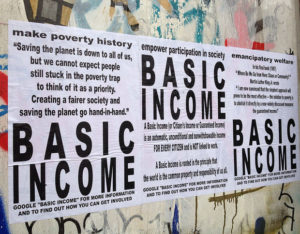
    What about a guaranteed income floor for everybody, with no work requirement tied to it?  If this sounds like pie in the sky when you die, think again. The Canadian province of Ontario already has a guaranteed basic income pilot project, and the national Green Party and most recently the Dekalb County Green Party hosted a presentation on the idea at their monthly meeting.

    Here’s what you need to know about Universal Basic Income in Georgia (UBIG)


    At a time when jobs are disappearing both through automation, outsourcing and worker exploitation (demanding one worker do the work of two), it is necessary to look for alternatives to “business as usual”.

    The concept of “Basic Income” is centuries old, however it’s opponents continue to use old arguments that have been disproven to keep it from catching on.  UBIG INC.ORG is taking on that problem by organizing Basic Income Activists to spread their fresh approach to getting the word out.

    The idea is, that all individuals receive a cash payment which does not require means-testing or have a work requirement. The benefits are numerous and significant. It provides an economic floor that supports people in transition, retirees as well as newly graduated worker.

    It relieves social tension within families due to illness, job loss or other life changing circumstances.

    It would provide relief and the possibility that a person could go to school, develop their talents, care for someone, or start a business.

    Income security can contribute to less violence, crime and drug use. Improved relationships, improve working lives and a more creative and happy society.

    There are many proposed ways for paying for Basic Income, for example cutting corporate welfare or taxing corporations that outsource or replace workers with automation. The possibilities are many.  Elon Musk has stated that Basic Income will become inevitable in the future, because of automation.

    Recently countries like Finland, and Netherlands. Ontario, Canada’s largest province plans to soon launch a basic income pilot program in Hamilton.

    First nations people in the United States already receive Basic Income from state revenues from the sale of natural resources, as do citizens in other countries.

    In Georgia, UBIG has a very precise approach, providing Basic Income but also counseling for recipients to help them manage their money and realize their dreams.

    But the process of educating an over-worked, insecure population is not easy.

    UBIG has solved that problem by conducting a social experiment in Georgia.

    UBIG will provide $1000 a month for a year, for 100 individuals chosen by the public.

    To enter Georgia resident need fill out a survey which asks, what would you do if you had an extra $1000 per month?

    The genius of this is that everyone who enters has a chance to win – why wouldn’t you want to share this with your friends and family.

    Once the public is made aware of what Basic Income is, and is not, the chances go up significantly that it will be passed into law in the State of Georgia.

    There is precedence for this in Georgia. Medical marijuana was once totally written off in the state, yet became law within only four years.

    For all these reasons the Dekalb County Greens have begun educating their members about UBIG. Think about it.  Better yet, do something.

    For more information go to WWW.UBIGINC.ORG.

    The Green Party is the only US political party that stands for a Universal Basic Income.  Consider joining the Georgia Green Party, the only party that fights for you, at our minimum dues level of only $10 per month. Click here to make that happen.

    The Platform of the Green Party of the United States includes:

    IV. Economic Justice & Sustainability

    D. Livable Income

    We affirm the importance of access to a livable income.

    1.  We call for a universal basic income (sometimes called a guaranteed income, negative income tax, citizen’s income, or citizen dividend). This would go to every adult regardless of health, employment, or marital status, in order to minimize government bureaucracy and intrusiveness into people’s lives. The amount should be sufficient so that anyone who is unemployed can afford basic food and shelter. State or local governments should supplement that amount from local revenues where the cost of living is high.


  • A Lot of What You Know About Korea is Racist Nonsense

    Pyongyang is not crazy

    by ANDREW DOBBS

    Check out our follow up piece here.

    Less than three months into Pres. Donald Trump’s reign we can already say that there is a non-trivial chance that the United States will soon be engaged in a nuclear war.

    The threat is still remote, but all the pieces are in place. An aircraft carrier group en route to North Korea, anonymous sources threatening a preemptive strike against them, a recent unilateral attack on the Syrian government and the dropping of a 21,000 pound conventional bomb in Afghanistan — interpreted by many as a message for North Korea.

    Any misjudgments or mistakes could easily spark a shooting war in which the North Koreans will face an existential threat they can only resist with their nuclear weapons. The United States would be likely to respond in kind.

    The main thing standing between us and this scenario? The cooler heads and good judgement of Trump and Kim Jong-Un.

    This is deeply concerning, but to hear the U.S. media tell it all of the irrationality and risk in this is on the North Korean side. NBC News, in the very article announcing the United States’ threat of unauthorized aggression against North Korea, called it “volatile and unpredictable.”

    Australia’s defense industry minister called North Korea “the world’s greatest threat” less than a week after the United States escalated the major power conflict in Syria with little warning. And The New York Times spoke of China’s need to “rein in” the childish North Koreans, even if the United States is the one that’s killed at least 1,000 civilians in combat since the beginning of 2017.

    Western propaganda draws from a deep well of racist “yellow peril” prejudice to stoke irrational fears against this tiny, poor, isolated country, and it amplifies this paranoia with long-standing stereotypes of East Asian “oddity” to dehumanize North Koreans and justify U.S. aggression against them.

    In the hands of a war-horny bigot like Trump, this well-established, bipartisan narrative poses a fearsome threat of making nuclear war inevitable. It’s imperative that we answer these lies immediately if we are to minimize this risk.

    There are three basic pieces to the West’s slander of North Korea — that the whole country is “crazy” and especially dangerous, and that North Koreans are treacherous and untrustworthy. They can’t be reasoned with, they won’t honor any diplomatic agreements, and any moment they could fly off the handle and kill millions of people for no reason whatsoever.

    This demands extraordinary military pressure from the United States and allies and may, alas, require us to destroy them.

    Each of these is a perverse misrepresentation. The claim that they are insane in particular is a terrific example of gaslighting — an abuse tactic where the perpetrator takes steps to make their victim act or feel crazy and then uses those responses as proof of the victim’s irrationality, a justification for further abuse.

    North Korea, by way of context, is bordered on the north by China and the south by South Korea. South Korea hosts 28,500 U.S. soldiers, sailors, Marines and airmen, many of them literally amassed at the border with the North. On their east is the Sea of Japan (known to Koreans as the East Sea), and across that is a nation which brutally occupied Korea for decades.

    The North Koreans are surrounded on all sides by countries that have invaded or occupied them in living memory, and the world’s most powerful military is still technically at war with them and poised to invade at moment’s notice.

    This is the sort of scenario that would make any country not merely paranoid, but legitimately insecure. In light of U.S. military aggression against countries that choose to resist our global order — see Iraq, Libya, Syria, etc. — North Korea can choose to capitulate or focus tremendous resources on building up their defensive capabilities.

    USS ‘Carl Vinson’ heads toward South Korea in March 2017. U.S. Navy photo

    Also in living memory there is the time the United States killed a quarter of the North Korean population and leveled the country’s urban centers, leaving almost no structures standing in Pyongyang. The North Koreans didn’t capitulate then and it isn’t on the table now — defense and defiance it is, and this is hardly “crazy” in context.

    The U.S. media, however, never provide this context and instead they present North Korean military propaganda as being unhinged and aggressive. They never compare this, of course, to U.S. military flyovers at sporting events or the ceremonial induction of new soldiers at halftime, or even to our National Anthem with its celebration of bombings and rockets and warfare.

    If North Korea is “crazy” for its militarism, then the United States is downright certifiable.

    U.S. propaganda can dismiss North Korea’s legitimate concerns so easily because of the underlying racist assumption that these are a bizarre and simple-minded people that believe in things like unicorns. This feeds off of and into orientalist logic that sees East Asians as a nearly subhuman “other” that can’t be reasoned with and so must be handled with force.

    It worked when we needed to justify violence against immigrant laborers in the 19th century and it works to justify our imperialist expansion today.

    As for claims about North Korea’s unique danger to the world, this too is divorced from reality. The country has no meaningful power projection capability — its naval surface vessels can’t operate more than about 50 kilometers off the coast — and the U.S. military has them contained to the south. China is still North Korea’s ally and does not view it as a significant military threat. North Korea is contained.

    But what about those missiles and nukes? The North Koreans could maybe lob a missile at Japan — or maybe not, a missile test on April 15, 2017 failed — and they could level Seoul with artillery alone. But why would they ever do this?

    The only way to explain such a unilateral assault on any of their neighbors — which would prompt either U.S. or Chinese military assets to overwhelm and destroy them — is to go back to that same baseless “crazy” claim. They could miscalculate of course, but claims that they are especially dangerous almost always rely upon the assumption that they might just wig out and bomb everybody for no reason at all at any moment.

    Again, this is rooted in an infantilizing, dehumanizing, racist logic.

    And any claims of a direct North Korean threat to the United States is ludicrous bullshit. They have no weapons capable of reaching anywhere within thousands of miles of the United States, and are years away from developing it, at best. Even if they reach that goal — which their very uneven history of missile tests indicates will be very difficult — they would still have thousands of fewer weapons than we do.

    U.S. Secretary of State Rex Tillerson visits South Korea in March 2017. U.S. State Department photo

    Any launch of that sort would represent an act of mortal desperation — again, it would be totally delusional to launch it offensively. Cable news is a much bigger threat to U.S. security than North Korea ever will be.

    So if North Korea’s military threat is totally derived from their desire to preclude a US attack why not negotiate a peace between our country and theirs? If they had that sort of assurance we could both back away from the brink and perhaps even provide space for an opening in North Korean society.

    Conventional wisdom answers that the North Koreans have reneged on every agreement ever made with them. But if the “crazy” claims are an example of gaslighting, this answer is a textbook case of projection. It’s not the North Koreans who have betrayed past agreements, but the United States. To cover this up we repeat the same racist logic we used against Native Americans — we broke the treaties, but they were the “Indian givers.”

    The main incident here has to do with the “Agreed Framework between the United States of America and the Democratic People’s Republic of Korea,” signed between the two countries in 1994. The Agreed Framework — as it is usually called — basically traded the end of North Korea’s nuclear weapons program for normalized economic and diplomatic relations with the United States.

    As a good faith step to spur the negotiations North Korea submitted to limited weapons inspections while the United States cancelled military exercises with South Korea. North Korea also used its plutonium production plants for energy, so the United States agreed to work with allies to provide them with fuel oil until two light water nuclear reactors — nuclear power plants that cannot be weaponized — could be built.

    The United States failed to uphold its end of the agreement almost immediately. Two weeks after it was signed, Republicans took back Congress and labeled the agreement “appeasement.” They never provided sufficient funds for providing the fuel oil and the United States never met the obligations set in the Agreed Framework.

    The Americans also failed to take even the first preliminary steps in building the light water reactors for over four years, and then moved at such a slow pace that there was no chance of meeting the timelines set in the Framework.

    Finally, and most significantly, Congress blocked any attempts to begin normalizing relations between North Korea and the United States and Pres. Bill Clinton never pressed it to do so.

    North Korea played along for at least four years and even warned us that it was going to restart its nuclear program a year before it actually began a pilot program. According to Leon Sigal, author of Disarming Strangers: Nuclear Diplomacy with North Korea, the North Koreans did not shift from this pilot effort to a full-scale weapons program until Pres. George W. Bush refused new negotiations in 2001.

    North Korea “was playing tit for tat — cooperating whenever Washington cooperated and retaliating when Washington reneged, in an effort to end enmity,” Sigal wrote in 2007. This extended to the later Six Party Talks between North and South Korea, the United States, China, Japan and Russia which almost brought North Korea back into the Nuclear Non-Proliferation Treaty.

    Talks broke down when the United States refused to release $24 million frozen in a Macau bank account, and North Korea tested its first nuclear weapon six months later. But for that $24 million there might be no nuclear threat from North Korea today.

    The fact is that America set such a low priority on disarming North Korea because it isn’t dangerous to the United States because it have nukes. The North Koreans are dangerous because they refuse to submit to our imperial authority and play ball with our global order.

    Notice how much less hand-wringing you hear about Pakistan, even though it does have a nuclear arsenal probably 15 times the size of North Korea’s, while also actively collaborating with jihadists. The Pakistanis are subject to the U.S. empire, however, and they buy their weapons from the U.S. military-industrial complex, so they are no big deal.

    North Korea dares to not only maintain its independence, but to defend it by any means necessary. It can’t be rewarded with negotiation. America has to destroy North Korea to teach the rest of the world a lesson, and this means preparing the U.S. public for nuclear war, painting the country as a bunch of war-crazed military aggressors whose word can’t be trusted.

    Again, this is the definition of projection, taking advantage of racist assumptions baked into U.S. politics and culture.

    The good news is that it appears that North Korea is acting both rationally and politically — not militarily — right now. The country is playing the present crisis in such a way as to encourage a favorable outcome in South Korea’s upcoming snap presidential election.

    A friendlier government there could mean new economic and political opportunities as well as new diplomatic backup that could help shift the balance in any future negotiations with the United States.

    Unfortunately the North Koreans are lined up against the regime of an insulated, ignorant, white supremacist warmonger who has learned in the last few weeks that the same forces lying about North Korea kiss his ass when he escalates military conflicts around the world.

    It’s our responsibility to push back against our government and against the institutions lying their way into nuclear war.

    It’s our responsibility to speak the truth about North Korea — even if it challenges our most deep-seated political assumptions — and it’s our responsibility, always, to stay defiant.

    Writing is hard. Money is short. Support this reporter. Follow DEFIANT on Facebook and Twitter.

    Democrats and Republicans alike are howling for war with Korea.  Big up the fight for peace.  Join the Georgia Green Party at our minimum dues level of only $10 per month.

  • Georgia Is Choking on Chemicals; Greens Demand Pure, Sustainable Living

    By Rachel Gray, Cobb Greens & Friends

    Georgia Greens March Against Unethical, Anti-Science Experiments on Food Supply, Ecosystems and Public Health

    It is no longer enough for nature enthusiasts, activities and scientists to be environmentally friendly. Our Green-focused families, sustainable communities and grassroots movements must be eco-conscious, reconstructing both U.S. agriculture and global trade policies. Georgia Greens, in cooperation with the March for Science on Earth Day, implore scientists to demand their research and funding be dedicated to enacting policies to make much-needed progress for the public good. Publically-funded, government agencies must stop choosing to line the pockets of billionaires operating massive chemical companies, who always choose profit over people and planet.

    Despite decades of using toxic chemicals in food production, the promise of eradicating hunger by this irrational approach remains a sick joke. Instead, the Green Party stance makes it very clear: There is a fundamental conflict between economic growth and environmental protection…An optimum size of the economy is reached which maximizes human welfare in a holistic sense.

    Deadly Chemicals Compound Risks

    In a 2013 survey, 71 percent of Americans expressed a concern over the number of toxins and pesticides in their food supply. Yet, more than 1 billion pounds of chemicals are used each year in the U.S. alone. “Worldwide, an estimated 7.7 billion pounds of pesticides are applied to crops each year, and that number is steadily increasing.”

    Scientific studies and laboratory research has found alarming amounts of the weed killer, glyphosate, in nearly every food product. Roundup — the world’s most widely used herbicide, coated on both GMO crops and conventional fields, as well as public parks and other landscaping spaces — is manufactured by Monsanto, which got its start in 1902 producing saccharin, later moving into synthetic rubber, PCBs, AstroTurf, Agent Orange and aspartame.
    Through industrialized food production, this insecticide is fed to our livestock and to our children, poisons farm workers, contaminates water supplies, degrades soil, pollutes air quality, kills wildlife and could cause antibiotic-resistant pandemics. These chemical compounds are found in common, every-day and even iconic processed foods from cereals and cookies to baby food and honey to fruit and farmed salmon.

    Many anti-chemical (pro plant-based/all-natural) activists have been pushing for the U.S. government to properly investigate if glyphosate is linked to the nation’s rising childhood cancer rates. And, as an endocrine disruptor, glyphosate has been tied to disrupting hormones, leading to reproductive problems like birth defects, infertility and neurological disease. And, this carcinogen kills good bacteria needed for proper gut health, leading to inflammation and diabetes.

    For 35 years, the EPA has known about the harmful, cancer-causing side effects of agrichemicals, often waiting to release this evidence until conflicting reports by the manufactures could refute, or at least dilute, the evidence. This long-anticipated evidence proves the U.S. government conspires to push for the use of more chemically-intensive, corporate-dominated, industrialized, toxic, wasteful farming methods  rammed through our nation’s precious land resources by Monsanto, Bayer, DuPont and Dow Chemical.

    The collusion is most evident by presidential administrations and their cronies purposefully causing our regulatory system to fail in protecting the American people. The trail of toxic policy from the White House started with former Monsanto executive Donald Rumsfeld, who held prominent, high-ranking positions in the Ford, Regan and Bush Jr. administrations. The influence continued with Obama’s quick appointments of other top Monsanto executives to the USDA, FDA and other agri-business agencies, and their successful influence is evident in Obama’s support of the failed Trans-Pacific Partnership and his signing of the Dark Act, which “blocks the U.S. Food and Drug Administration from ever implementing mandatory GE food labeling, and allows food companies to continue to make misleading ‘natural’ claims for foods that contain GE ingredients.”

    Genetic Splicing of Plants Loses Ground

    In March of 2015, the International Agency for Research on Cancer (IARC), a division of the World Health Organization, said the herbicide glyphosate is ‘probably carcinogenic to humans.’ This year, the UN Human Rights council released the ‘Report of the Special Rapporteur on the right to food,’ which accuses global pesticide conglomerates of systematic denial of harms, aggressive, unethical marketing tactics, and heavy lobbying of governments that has obstructed reforms and paralyzed global pesticide restrictions, which have catastrophic impacts on the environment, human health and society as a whole, including an estimated 200,000 deaths a year from acute poisoning.

    In February, DuPont and Chemours Co. agreed to pay about $671 million in cash to settle more than 3,500 lawsuits related to the leak around a West Virginia manufacturing plant of a toxic chemical used to make Teflon (perfluorooctanoic acid, known as PFOA or C-8, used to make the nonstick coating on pots and pans, which has been linked to cancer and other diseases.) And last month, the state of California began requiring Monsanto to label their weed killer, in accordance with the Safe Drinking Water and Toxic Enforcement Act of 1986.

    But industrial chemicals pesticides are just some of the lucrative pillages of industrialized farming. Genetically modified/engineered organisms (seeds) are ‘crafted’ to contain bacterium that produce toxins to kill weeds and pests, or are manufactured to be so resilient as to remain alive while continuously sprayed with killer chemicals to deter insects — possibly collapsing entire colonies of bees and other pollinators. GMOs has the known effect of causing weed and pest strains to genetically mutate for greater resistance, which allows multinational agri-businesses to pump out more chemicals and more engineered seeds to combat the problems these false ‘scientific solutions’ are creating.

    The modified plants are ‘made’ tougher as well, with each cycle reducing the amount of nutrients absorbed by the plants, making the food supply less nutritious and limited on yield. All while profits soar on this type of intellectual, patent-friendly, property. There is no doubt that , sustainable economy and much more benefit to independent, local, family farmers.

    Small-scale, organic (non-chemical/natural fertilizers, pesticides and herbicides), GMO-free farming is the only way to feed the world. Studies have shown the consumption of an organic diet significantly reduces pesticide exposure in adults. The good news is that organic farmland in the U.S. hit a record 4.1 million acres in 2016, an 11% increase in two years, with alfalfa/hay the leading crop. The bad news is Georgia only accounted for 7,832 acres, being far outpaced by North Carolina (21,688), Indiana (40,380) and most plains and western states, which average more than 100,000 acres each.

    Georgia Greens Encourage Growth from the Grassroots

    Being part of the Green Party community means being part of an international movement to combat this global toxic epidemic, from India to most of the European Union. Instead of flooding the Caribbean, Africa and other developing regions with subsidized GMO rice and corn, it is time for some real ecological economics. A true Green food system in America must be promoted through the Economic Justice & Sustainability platform of the U.S. Green Party – which respects the human right to safe food and the liberty to grow, consume and trade natural food.

    “Green economic policy places value not just on material wealth, but on the things which truly make life worth living — our health, our relationships, our communities, our environment, and building peace and justice throughout our nation and the world…Production is best for people and planet when democratically owned and operated by those who do the work and those most affected by production decisions (co-operatives). This model of worker and community empowerment will ensure that decisions that greatly affect our lives are made in the interests of our communities, not at the whim of centralized power structures of state administrators or of capitalist CEOs and distant boards of directors.”

    Georgia Greens support strong local economies and regional trade from self-sufficient production, without corporate control and unwanted, unwarranted intervention. This includes true-cost pricing (like a carbon tax), eliminating waste with composting and closed-loop durable goods, as well as minimally producing and clearly identifying toxic chemicals. Greens must demand chemical producers adhere to independent testing, with transparent oversight. Greens must protect ‘traditional’ farmers’ rights and seed storage. Greens must insist our governmental regulators hold manufactures financially and criminally liable for the harm these chemicals inflict on communities and wildlife. And, Greens must immediately implement processes to ensure the public’s right to know what is in our food from raw to processed forms.

     Turn Your Green Passion into Action

    1.      Purchase or even make chemical-free household products like cleaners and detergents.

    2.       Tell Trump to regulate GMOs. (The administration is accepting public comments right now.) And,sign this petition, to demand the immediate investigation of Monsanto, and hold the EPA accountable.

    3.       March for Science in Atlanta, inSavannah or inAthens on Earth Day, April 22. And, prepare toMarch Against Monsanto in May!


    And stay tuned for a future article, Go Green, Grow Hemp & Get High, where we fight back against the petroleum-based plastics industry, and demand hemp finally be implemented as the superior industrial, medicinal and recreational plant that it is!


    Democrats and Republicans alike are in the pocket of chemical companies, of Big Ag, Buig Pharma and the rest.  Only the Green Party fights for the right to a clean and healthy environment.  Help us make that happen by joining the Georgia Green Party at our minimum dues level of only $10 per month.

Η ατμόσφαιρα ενός πραγματικού καζίνο ζωντανεύει στο live καζίνο Trino.
Για όσους αναζητούν άμεση δράση, το καζίνο Spinbara αποτελεί μία από τις καλύτερες επιλογές.
Η NV Casino άμεση σύνδεση σας επιτρέπει να συμμετέχετε σε ζωντανά τραπέζια ρουλέτας.