You are encouraged to test this form, but not to rely on it to actually process a contribution to the party. It is currently wired to a test credit card processor, and will not process a real debit card. I would appreciate hearing from folks about how this works for you. If you have any feedback on the user experience provided by this service, please send an email.
For your tests, please use as your debit card, 4242-4242-4242-4242 (only without the hyphens). Choose any card expiration date in the future and any three or four digit cvc code.
In the last meeting of the state committee, called by Bruce Dixon in his capacity as Co-Chair of the Georgia Green Party, its members were unanimously agreed in his absence, on the adoption of a Dixon resolution to call this year’s annual meeting of the party. By the time we gathered a quorum of the state committee to hear the proposal, Bruce had been sedated for two days, and would make his departure early the next afternoon.
Greens from across the state are urged to gather, Saturday, August 17th, from 10:00 am until 4:00 pm at the Arts Xchange in East Point Georgia, 2148 Newnan Street; 30344. We will meet in the Ebon Dooley Studio, elect members of the state committee and our national delegation and consider proposed changes to the state party bylaws and the platforms of the state and national parties.
Claudia Ellquist, a delegate to the National Committee and two time Green Party candidate for County Attorney in Pima County Arizona, died Sunday, November 18th, 2018 at the age of 70. Party activists were alerted by a forwarded email from her husband of twenty-four years, John Yoakum.
She is remembered by her colleagues among the national party leadership as thoughtful, as ‘a great leader, penetrating in her analysis, caring about others, and a pillar of strength for the Green Party’, as ‘(o)ne of the wisest, (most) intelligent and compassionate people I have had the opportunity to know’, as ‘a voice of reason and kindness (who) will be missed by all’, for ‘her personal calm’ and reasonableness, for her insight and compassion.
Claudia Ellquist was a member of the National Women’s Caucus of the Green Party of the United States, and served as a Delegate for the Arizona Green Party to the Green National Committee. She served at the time of her death, as the First Vice Chair of the Arizona Green Party. Ellquist ran four times for Pima County Attorney, twice as a Green, in 2004 receiving 23,028 votes for 7.64% of the total vote and in 2008 earning 22,747 votes for 6.31% of the total. Her campaigns supported her work to abolish the death penalty.
She led the host committee which brought the Annual Meeting of the Green Party of the United States to Tuscon Arizona in 2006. During the event she organized a tour of her church which was a center for organizing in solidarity with immigrants risking a desert crossing on their journey North. She described the battles between her congregation, which stages in the desert, water for migrants and the vigilantes who would poison the water or just as deadly, puncture the containers, wasting the water into the desert sand.
Writing of Kavanaugh, in a recent op-ed (and here) meant to convey the appreciation of the National Women’s Caucus of the Green Party of the United States for the testimony before the Senate Judiciary by Professor Christine Blasey Ford, Claudia Ellquist wrote:
“If he had Come to Jesus decades ago, confessing himself — not waiting, closeted, for an accusation — about what he almost did, and, as significantly, what he did. Then he would have had time to turn his life around, to see women as real human beings, and to see fear and hurt and harm for what they are. But our society abandoned him too, not teaching him to take responsibility, or even believe that there was responsibility to take.”
Delegates to the Green National Committee from both Delaware and Kansas report that this quote of Claudia, hangs on their walls.
“People who disagree with you are not your enemies. Only people who try to dominate you are your enemies. Learning the difference can make us all so much more effective.”
– Claudia Ellquist
Quoting from her obituary, “(Claudia Ellquist) was born in Duluth, Minnesota . . . then mov(ed) extensively with her military family to numerous places including Japan. She moved to Tucson (Arizona) in 1962. Claudia graduated from Palo Verde High School, University of Arizona and University of Arizona Law School in 1976. That time included a two year church stay in San Francisco for a Lutheran and Episcopal church mission. Claudia spent a brief time practicing law and 40+ years on community activism, including church activities, women’s organization and the Green Party. . . . She ran for Pima County Attorney four times in order to highlight the elimination of the death penalty as a public issue. . . . She organized NOW chapters at the city, county and state levels and served on the national board of directors for NOW. Claudia was an original member of the Arizona Clean Elections Commission, first appointed by the Arizona Legislature in 1999. She has worked tirelessly with Church Women United (CWU), Disciples Women’s Fellowship, and First Christian Church. She has received a cash award from the Tucson Festival of Books or her writing in the category of non-fiction memoir. She successfully organized the county-wide effort to recall the Pima County Tax Assessor in 1994. Claudia subsequently organized volunteer efforts to pass Healthy Arizona I (Prop 203) and Healthy Arizona II (Prop 204) which successfully brought Medicaid to the state after 30 years without it. . . . In lieu of flowers, people are encouraged to work for passage of the ERA or (to make) a charitable donation to NOW or to the charity of their choice. A memorial Service will be held at First Christian Church, 740 E Speedway, on Saturday, December 1st at 11am.”
Congratulations to Jimmy Cooper are in order for an excellent write-in showing. He showed stronger results than our entire 1998 slate, or if memory serves, any other of our candidates except Nan Garrett and our Presidential slates.
‘Legislated off the ballot’, as Party Chairman Bruce Dixon often puts it, the Georgia Green Party was left to run the two candidates of its 2018 slate as write-ins. John Fortuin turned his attention elsewhere, to media work and research (see his report on cronyism in Georgia election policy, mentioned in the previous issue). But Jimmy Cooper was undeterred by the ballot access barriers and proceeded with his Fall campaign. His work was visible in the results.
To summarize, the Secretary certified results including a total of 564 votes for Green Party nominee Jimmy Cooper for Georgia’s 8th Congressional District. Those numbers include: 244 votes from Bibb County, 108 votes from Lowndes County, 134 votes from Houston County and 78 votes from the other nineteen counties combined.
Only one write-in candidate showed a stronger finish in this year’s results, Emily Leslie delivered 600 write-ins in her bid for House District #106.
2020 is a Presidential Election year, and the Georgia Green Party will have the opportunity to nominate 16 candidates for the Electoral College. But to do so it must deliver 54,431 valid signatures. Signature collection can begin on April 15th 2019, three and a half months from now.
Contested primaries build parties.
If we had 100 Green candidates across the state contesting for sixteen seats in the Electoral College, each committed to collecting 1,000 signatures before December 31st, 2019, we’d have secured the ability of our state party’s 2020 convention to nominate its candidates for statewide office by convention; and geared up to work for the ballot access of a slate of local candidates starting January 9th, 2020. A successful petition drive will also permit us to nominate candidates in the state-wide US Senate and PSC races scheduled for 2020.
If you’d be interested in participating in this ballot access strategy, to put Green candidates for public office on Georgia’s ballot in 2020, please let our state party officers know, by writing the address below, and watch for announcements of upcoming materials and programs designed to support those actions you take to create a visible presence for the Green Party in your own community.
Get ready a crude awakning as energy companies get the regs relaxed to ship oil by rail (bomb trains) almost everywhere.
While a second oil-by-rail boom is well underway in North America, both the U.S. and Canada are taking steps that ignore or undermine the lessons and regulatory measures to improve safety since the oil train explosions and spills of years past.
Canadian oil-by-rail now is operating at record levels, which are predicted to double by 2019. Favorable economics have led to a recent rise in oil-by-rail movements in the U.S. as well, with more Bakken oil moving by train to East Coast refineries.
Meanwhile, in September the Trump administration finalized its rollback of a regulation requiring an updated braking system for oil trains, known as modern electronically controlled pneumatic (ECP) brakes, in a highly questionable regulatory process detailed on DeSmog last year.
In North Dakota, the Department of Mineral Resources now plans to reverse a regulation which required even the minimal stabilization of oil transported by train, with “stabilization” referring to a process that removes some of the natural gas liquids that make Bakken oil so explosive. That move doesn’t bode well for avoiding earlier scenarios in which rail operators dubbed oil trains as “bomb trains.”
In September Canada committed to phasing out some of the unsafe older rail tank cars ahead of schedule, but a derailment earlier this year shows that this step is far from foolproof. On June 22, a train carrying Canadian oil that derailed in northwestern Iowa was using the newer DOT-117R tank cars, the same ones being phased in as the new standard. The derailment still resulted in the release of an estimated 230,000 gallons of tar sands oil into local floodwaters.
And while track defects are the leading cause of train derailments (which, of course, lead to fires, explosions, and spills), the Trump administration has hit pause on efforts to regulate rail wear, which makes unlikely the possibility of new rules on this issue while Trump is in office.
Regulator’s Statement on Modern Braking Systems Inaccurate
On September 24, the U.S. Pipeline and Hazardous Materials Safety Administration (PHMSA), the regulatory agency that oversees the transport of oil by rail, announced its final decision to undo the regulation requiring modern ECP braking systems for oil trains. But its statement explaining the rationale for the rollback was misleading.
First, however, it should be noted that the current head of PHMSA is Howard “Skip” Elliott, who retired from his position as a rail executive at CSX before taking the job as federal regulator of the industry he just left.
This line from the agency’s announcement gives the appearance that new research provided justification for the decision:
“The updated RIA [Regulatory Impact Analysis] incorporated new findings from ECP brake testing conducted by the Federal Railroad Administration, which were reviewed by the National Academy of Sciences.”
However, as detailed on DeSmog, the entire process used to justify this regulatory reversal was deeply flawed. This was simply a case of the rail industry not wanting to pay for the safety that upgrading its fleet to ECP brakes would provide. It was not a decision based on “new findings” that somehow reversed the many years of research proving ECP brakes are superior to the current air brake system (which dates back to the 1860s).
All of this should come as no surprise. As DeSmog reported in 2015, shortly after PHMSA proposed these regulations, Mathew Rose, CEO of oil-by-rail giant BNSF, said that “this rule [ECP braking requirement] will have to be changed in the future.”
To review why the Trump administration’s repeal of an important oil train safety measure is a political, rather than evidence-based, decision, just turn to the Federal Railroad Administration (FRA), but under previous presidents.
As DeSmog reported, in 2006, Joseph Boardman, FRA administrator under George W. Bush, explained why updating trains with ECP brakes makes perfect sense: “ECP brakes are to trains what antilock brakes are to automobiles — they provide better control.” Boardman also is on the record saying that ECP braking “offers a quantum improvement in rail safety.”
In 2015, under Barack Obama’s administration — when the rail industry began its push to repeal the new ECP braking rule — Matt Lehner, FRA communications director at the time, told DeSmog:
“ECP brakes are a proven technology that will reduce the number of train derailments and keep more tank cars on the track if a train does derail. Delaying the adoption of ECP brakes seriously jeopardizes the citizens and communities along our nation’s freight network.”
North Dakota’s Safety Rule That Did Almost Nothing for Safety
North Dakota’s move, which would undo a vapor pressure requirement for Bakken oil prior to rail transport, demonstrates how much sway the rail industry has in the state at this point.
This vapor pressure standard, nominally intended to stabilize volatile oil on trains, requires the transported oil to have a Reid Vapor Pressure lower than 13.7 pounds per square inch (psi). Higher vapor pressure in a rail tank car, like in an aerosol can, increases the likelihood of explosion if the unit is damaged or punctured during a derailment or crash.
However, as I wrote in 2014, North Dakota’s rule was essentially meaningless.
The majority of oil train accidents — including the one in Lac-Mégantic, Quebec, that killed 47 people — have involved oil with a vapor pressure lower than the North Dakota standard of 13.7 psi. Therefore, the state’s regulation did very little to improve safety for oil trains in the first place.
But now the rail industry is saying that oil vapor pressures usually only exceed 13.7 psi in the winter, and because of that, vapor pressure testing shouldn’t be required year round.
Yet the industry has always maintained that the volatility of Bakken oil was never a problem. In May 2014, The Wall Street Journal ran a story with the headline: “Bakken Shale Oil Safe for Rails, Industry Group Says.”
And while a half dozen state attorneys general and a coalition of environmental groups separately have called for a national standard for vapor pressure on oil trains, the Trump administration has done nothing on this issue.
What North Dakota is doing now won’t change oil train safety one way or the other. But, again, the move highlights the complete lack of industry consideration for stabilizing oil, a trend DeSmog has documented many times over the years.
As a result, the second oil-by-rail boom now ramping up will occur with the same void of safety rules as the first and with the same dangerously volatile oil — from Texas to North Dakota to Canada — filling the mile-long “bomb” trains crossing the continent.
Trust the Trump Administration on This One Point
Washington State Governor Jay Inslee is a vocal advocate for improving rail safety and earlier this year put the final nail in the coffin of what would have been the nation’s largest oil-by-rail terminal, proposed for Vancouver, Washington. When Inslee commented on the recent rollback of the ECP braking regulations for oil trains, he told Oregon Public Broadcasting:
“One thing you can trust about this administration, they’re going to sell out your safety for special interests.”
Considering the string of fiery, explosive, and deadly incidents during the first oil-by-rail rush, North America should expect the same performance from the oil and rail industries the second time around.
Corporate Democrats don’t defend people’s rights when they are in power, but with Trump in the White House the Democrats now “pretend to care so deeply about racism and patriarchy,” said Crystal Fleming, Associate Professor of Sociology and Africana Studies at Stony Brook University. Fleming is author of the new book, How to Be Less Stupid About Race.
The midterm elections are a week away and I can’t find anybody worth voting for. I live in Georgia, the 6th congressional district, where Stacey Abramsis the Democrat running for governor, and Lucy McBathis the Democrat congressional candidate. McBath is running four points behind Republican incumbent Karen Handel. Stacey Abrams has been polling only two points behind Brian Kemp well within the polling margin of error for months now.
For those outside Georgia, if Donald Trump is some kind of horrible bad grandpa Brian Kemp is an especially mean uncle out of Athens GA, normally a pretty liberal college town. Kemp ran commercialsin which he blew up stuff, fired up his big chainsaw to cut regulations, waved his guns that nobody better try to take, and slammed the door of that big truck he’s got in case he has “…to round up some criminal illegals and take ‘em home myself.”
Republican Kemp has been GA Secretary of State, in charge of Georgia’s elections for eight years now, during which time he’s struck about a million or so mostly minority voters off the rolls, interfered with voter registration drives, and caused several tens of thousands of other new voter registrations to simply disappear. This is standard Republican practice across the country because the numbers of their dependable vote are shrinking. So Republicans try to hold down the vote in Democratic areas, and Democrats try to maximize registration and turnout.
6th district congresswoman Karen Handel was Brian Kemp’s predecessor in the office of Georgia Secretary of State for eight years. In that capacity she disappeared her own share of minority votes and voters. She also had a hand in cooperation with the crooked Democrat who held that office before her, in bringing Diebold’s faith based voting machines into Georgia.
The Democrat running against Handel is Lucy McBath. Her son was murdered in Jacksonville FL back in 2012 for the crime of playing his music too loud, and since then McBath has become a professional gun control advocate. The big problem though, with the professional gun control advocates are completely unable to point the way to a less violent society without telling the truth about America’s present and past. The narrative the professional gun control advocates spin around gun control generally ignores the official violence of police and the military. In the real world, the Second Amendment to the US Constitution was written to guarantee that every able bodied white man was armed and ready to take part in slave patrols or Indian killing and land stealing militias. When chattel slavery mostly ended and the theft of the continent was complete, the gun industry had to find other markets and other reasons for existing, and some of what they came up with included the myths about civilians with pistols being able to hold the government accountable and more.
An even bigger problem with Lucy McBath is that like many 2018 so-called progressive Democrat congressional candidates this year, McBath is running for US Congress without a single word to say about foreign policy, except a vow of support for the apartheid state of Israel. She’s a candidate for US Congress without a word to say about the four or five countries we’re bombing or the dozens of other countrieswe’re deploying US special forces in or flying drones over. Almost-a-congresswoman Lucy won’t talk to us at all about the 800 US military basesaround the world which cost us about a trillion dollars a year, more than what the next nine or ten nations spend put together, and reporters don’t ask. The Republicans don’t bring it up either, a sure sign that this is something they pretty much agree on.
And then there’s Stacey Abrams. Stacey is a tax attorney, Spelman and Yale Law grad from Gulfport MS. She was first state rep from an Atlanta district in 2006. In American legislatures, party caucus leaders are chosen by the amount they bring into party coffers in donations from PACs, corporations and wealthy individuals and their expertise in doling it out to other lawmakers. By 2011 Stacey Abrams was chosen Democratic leader in the GA House, a post which she held until beginning her run for governor in 2017. She’s written several romance novels on the side too.
Stacey Abrams wants to be president, and Georgia governor is one of the checkmarks on the way there, and election to governor will immediately put her on the short list of contenders. She lays that out quite clearly in her latest book Minority Leader How to Lead From the Outside and Make Real Change. It’s a memoir-centered self-help book, an I-did-it-you-can-do-it-too kind of thing with checklists at the end of every chapter. The “it” she talks about in the book is achieving power, but for all her deep understanding of how to maneuver to obtain this power Stacey offers very few if any clues about what great things she wants to do with that power.
We’ve seen that movie before though haven’t we? Didn’t we just finish eight years of an unaccountable black president presiding over the greatest loss of black family wealth since we started keeping statistics on it? Didn’t we just see three million American families lose their homes? Didn’t we hear Eric Holder, the first black attorney general tell us the banks to were too big to jail and too important to investigate, and didn’t we see Loretta Lynch the second black attorney general literally write the fine print on get out of jail free cards for CitiGroup and other criminal investors who walked away with billions. We’ve lived to see a black president break his word on raising the minimum wage and delivering single payer health care? The first black president blockaded and bombed all the countries the white presidents before him were blockaded and bombed and added a few new ones, including the actual overthrow of a prosperous African country, where black Libyans and other Africans are being traded as slaves right now. Didn’t we see the first black president expand fracking around the world, privatize big chunks of public education, and let all the torturers and kidnappers on the US payroll off the hook?
Given all that, why should we let Stacey Abrams and Lucy McBath and the rest off with not even a pretense that they’re accountable for their stands on all these issues where they intend to exercise the power granted by our votes? Why? Giving Stacey and the others room to figure out where they are on all this is not an option. They’re all bright and well informed people, especially Stacey. They know where they stand, they just don’t feel obligated to let voters know. And why should they? Stacey is running against a crew of frank and open racists. It should be enough for her to show up with advanced degrees from humble beginnings, both of her parents preachers and apologetically black, female with dreads. And what do governors have to do with foreign policy anyway?
Well, the truth is that governors conduct foreign policy all the time. So do local governments down to cities and counties, when they decide whether to do business with ICE. and how aggressive they want to be in funneling bodies into the ICE detention machinery. Joe Arpaio in Arizona certainly had his own foreign policy, so do Cobb and some other Georgia counties, and so does Brian Kemp. Stacey Abrams and her party will pay lip service to the scriptural notion that we are obligated to be kind to the stranger. But she surely knows that hundreds of thousands are fleeing Central America. Stacey knows knows the US has invaded and occupied and bullied and blockaded Central America countries about two centuries now, putting in place the governments of gangsters and military death squads that have made those places the murder and human trafficking capitals of the world. The Central American refugees are fleeing the hellscape that US military and economic intervention have imposed on their countries.
Brian Kemp and Donald Trump want to greet them with theatrical cruelty, and that sells, especially to frustrated white Americans looking for someone to blame for their economic insecurity. In the face of that, pleas for kindness to the sojourner don’t sell well. The truth – that the US created a hell people are fleeing from might sell, but it’s a place Stacey and her party have never laid the groundwork to go, and never intends to go. Hondurans elected a mildly social democratic president in 2014, and the black president’s secretary of state Hillary Clinton lost no time letting the world know she favored a military coup to oust him.
Stacey and her party never bothered to explain to Georgians what Medicare For All was, or to line up behind it. As a result we got the Affordable Care Act, in which health care for thirty or forty million was to come through Medicaid expansion vulnerable to interference in states under Republican control like Georgia which had the option of rejecting, and Georgia did just that. She also opened up more room for Brian Kemp to tell bigger lies about what Medicare For All is, and what Abrams represents. That day in Ebenezer Church when Congressman John Lewis told young black activists that free college tuition and health care were un-American Stacey was almost certainly in the room, and in definitely in agreement with Lewis.
If eight years of Obama taught us anything, it’s that a black president can do immense damage to the cause of black working class families. Showing up female with dreads and riding on black girl magic just isn’t enough, and keeping your politics on war and peace a secret till after you’re elected – as Stacey Abrams, Lucy McBath and a host of others are doing this year is a sign of pure contempt and real disregard for the folks she expects to support her political career. We have indeed seen this before. Lucy, Stacey and the rest can continue their careers without my vote, thank you very much.
There’s already a cohort of thirty or so CIA Democrats, Democratic congressional hopefuls straight out of the military, police, intelligence and homeland security world. Add those to the progressives who won’t speak on the subject, and it looks like any congressional blue wave that hits will be mostly blue dogs, right wing Democrats. We have indeed seen this one before.
For Black Agenda Report, I’m Bruce Dixon. Google and other corporate social media companies have actively limited the availability of Black Agenda Report in search results for more almost three years now, on the specious grounds that we might be under the influence of the Russians. The day isn’t far off when they might ban Black Agenda Report from Facebook or Twitter to protect people from news, commentary and analysis from the black left. So the only way you can be sure you’re getting fresh Black Agenda Report each and every week is to go to www.blackagendareport.com and hit the subscribe button which delivers summaries and links to all our new content each and every week to your email box, where corporate social media companies can’t block or even trace it, which is why they call email “dark social media.” Dark social media is the only social media still under our control, so subscribe.
Thank you.
Bruce Dixon is managing editor at Black Agenda Report and serves on the state committee of the GA Green Party. He can be reached via email at bdixon@georgiagreenparty.org
Georgia was one of the first places in the US, at the beginning of Governor Deal’s administration, to embrace what has come to be know as “bipartisan prison reform.” In the Obama and now the Trump administration, it’s gone national. That’s not a good thing.
A specter is haunting the United States — the specter of “bipartisan prison reform.” Although the last effort at bipartisan prison reformstalled out in 2014-15, the US now seems poised to pass the “First Step Act,” after Donald Trump signaled his support for the measure in a statement at the White House on Wednesday.
Passage of the bill would be a major victory for Trump. A number of liberal and progressive commentators have gone all in on the legislation, which has been heavily shaped by Jared Kushner and Koch Industries attorney Mark Holden. CNN commentator and Cut50 cofounder Van Jones praised Trump. “Give the man his due,” Jones tweeted, saying the president is “on his way to becoming the uniter-in-Chief on an issue that has divided America for generations.”
Yet, regardless of who is “uniting” around its passage, the bill itself is both weak and dangerous. While it offers a few token reforms — some of them, like the end of shackling for pregnant and post-partum women in federal custody, necessary and long overdue — it leaves many of the most pressing issues off the table. It barely makes a dent in terms of reducing the length of prison sentences or reducing the number of people in prison. Meanwhile, it heightens the use of racist and classist assessment mechanisms and expands the net of surveillance.
The proposed bill includes a few minor reductions in sentence length for federal prisoners, by expanding potential access to good time credits and lowering the age of consideration for compassionate release However, it will not make any sentence reductions retroactive (except for the 2010 Fair Sentencing Act, which minimized — but did not erase — the disparity between crack and cocaine sentences). This means that people who are currently serving, for example, life sentences for drug offenses will not get any relief from this bill. A press release from the National Fraternal Order of Police, which endorsed the First Step Act, indicates that the organization “engaged” with lawmakers to ensure that most sentencing changes would not be applied retroactively. Despite Trump taking a deserved pot shot at Bill Clinton’s support for punitive crime policy of the 1990s, the bill would leave intact the lengthy sentences and limited legal access that Clinton enacted in a trifecta of laws (the Anti-Terrorism and Effective Death Penalty Act, the Illegal Immigration and Immigrant Responsibility Reform Act, the Prison Litigation Reform Act).
The bill also expands the cruelties of “e-carceration.” These reforms use electronic monitoring and other forms of often-privatized surveillance to build what activists have dubbed “digital prisons” that fatten the wallets of prison telecommunication companies while further extending carceral control into people’s homes and daily lives. Vivian Nixon, a formerly incarcerated person and director of College and Community Fellowship, dubbed First Step “an insidious move toward expanded control and surveillance in our homes and communities.”
Additionally, the First Step Act relies on the same tried-and-terrible “risk assessment” algorithms that have been repeatedly proven to reproduce racism in sentencing. These risk assessment techniques demonstrate the deep conservatism driving the bill. Treating incarcerated people as entrepreneurial supplicants, the legislation seeks to “incentivize” their participation in prison programs — except that people who fail the “risk assessment” cannot access many of the benefits anyway. The Leadership Conference on Civil and Human Rights wrotethat the Act’s use of algorithms risks “embedding deep racial and class bias into decisions that heavily impact the lives and futures of federal prisoners and their families.”
We are seeing a dangerous combination of overwhelming Democratic support for this woefully misguided legislation and terribly misguided excitement for bipartisan cooperation with a white nationalist administration. This combination is bad policy — and bad politics.
In fact, one should scuttle any talk of bipartisanship. For Republicans, the First Step Act is a calculated political move. They want, first and foremost, to rescue their moribund, dying minority of a political party from the dust heap of history. The successful, if partial, overturning of policies that disenfranchise people with felony convictions in Alabama, Florida, Virginia, and elsewhere poses new political questions. Republicans can no longer ignore formerly incarcerated people or their families as a political constituency: 70 million Americans have criminal records, and mass incarceration is increasingly being felt in conservative white rural communities. Though the US prison system is thoroughly racist, there are still hundreds of thousands of white people who have been in prison or whose family members have. Some GOP strategists are hoping that they can be convinced to vote Republican. And indeed, many of them might.
The First Step Act needs to be seen in the context of both what the federal government can do in general on prison issues — and what this federal government can, or will, do. The federal government oversees two primary areas of punishment: the federal prison system and immigrant detention. The federal prison system is about 13% of the overall prison system — so no matter what the bill does, it will only impact a small portion of those incarcerated. (That, in and of itself, is not a reason to oppose it, but it bears mentioning for the sake of clarity.) Even if it wanted to — which it most assuredly does not — the federal government simply cannot enact the massive reductions in the US prison population that would be required to end mass incarceration. That fight remains strongest at the state and local levels.
Meanwhile, when it comes to immigrant detention, of course, the Trump administration is not even pretending to attempt to reduce the incarcerated population. The severity of this administration’s approach to immigrants and refugees reveals the punitive foundations of its worldview. This is, after all, the party of concentration camps for migrant children. The party of expanded detention and accelerated deportation. The party of raids on immigrant communities. The party of border walls, border fences, border guards, and border militarization. The party of the Muslim ban. The party of ending abortion and erasing transgender people out of legal personhood, both of which rest on expanded criminalization. The party of “lock her up.”
None of that has changed, nor will it. Six weeks ago, the administration diverted nearly half a billion dollars from medical research, FEMA, and other necessary federal projects to pay for its expanded regime of immigrant detention (including family separation). The First Step Act continues this nativistic violence by excluding undocumented immigrants as well as “people who are convicted of high-level offenses.”
In pushing the First Step Act, Republicans are hoping to score a public relations victory to stabilize their power. They are aiming to shore up their legitimacy while the party otherwise advances transparently dangerous and historically unpopular policies to strip people of their health care, right to organize, and environmental and personal safety. The First Step Act does not signal any change of heart or action by the core violence of this administration.
Such is the way of politics. Even white nationalist kleptocrats need to adjust to changing circumstances. Yet progressives do a dangerous disservice to give any comfort to this agenda. The First Step Act is only being debated as a result of the hard work that a large number of grassroots organizers have put in over the years and decades. Yet the bill evacuates many of their demands. As author, activist, and formerly incarcerated person James Kilgore tweeted, this act aims “to sideline voices of radical critics of mass incarceration/prison industrial complex. A moderate reform agenda like this will not bring us to 1980 levels of incarceration before the earth boils due to climate change.”
Bipartisanship requires a “middle ground” on which to find a mutually agreeable solution. And that middle ground has been fundamental to the development and maintenance of mass incarceration. Though Democrats and Republicans have at times disagreed on the particulars, both have shared what historian Julilly Kohler-Hausmann has called a “get tough” approach to limiting welfare and expanding punishment. Both parties have tried to solve social problems through expanding the power of police, the scope of prisons, and the scale of surveillance. Both parties have persecuted working-class communities of color through domestic wars on crime, drugs, gangs, and terrorism. Each new front in these wars has moved the middle rightward.
Ending mass incarceration will require more partisanship, not less. Stemming the rising tide of fascism will require more partisanship, not less. Partnering with Trump and company in the name of “bipartisanship” to achieve a few tepid reforms pretends that their extreme violence against Black, Native, Latinx, and multiracial queer and transgender communities is somehow separate from the field of prison rather than central to it.
There is no victory in walking the path of co-optation. Instead of trying to meet in the middle with white nationalists and corporate shills, progressives should be trying to make the middle ourselves: to build the common sense reasoning and policy platforms that advance new paradigms of justice, safety, and sustainability. We’ve got a world to win.
Since Donald Trump took office, progressive journalism has been under constant attack and companies like Facebook and Google have changed their policies to limit your access to sites like Truthout.
The result is that our articles are reaching fewer people at a time when we need genuinely independent news more than ever.
Here’s how you can help: Since Truthout doesn’t run ads or take corporate or government money, we rely on our readers for support.
By making a monthly or one-time donation of any amount, you’ll help us publish and distribute stories that have a real impact on people’s lives.
For a politician’s biography, the Sam Pollarddocumentary currently available on Netflix, which recounts the life and career of Maynard Jackson, the first of Atlanta’s six consecutive black mayors, is remarkably free of politics. But when you think about it, this should not be a surprise.
After all, politics in any and every historical era is how we humans address our collective affairs. Politics is how we struggle to determine who produces what for whom, and under which conditions. Politics is how we decide which groups of people get to access the resources and the wealth that the planet provides and which its people produce, and which groups see their needs ignored. It makes perfect sense then, for elites to protect themselves by constructing fake histories which portray their own triumphs as virtuous and inevitable, histories which minimize or deny the very existence of struggles from below conducted by and for the masses of people who actually produce the wealth which elites mostly take for themselves, histories stripped clean of inconvenient politics.
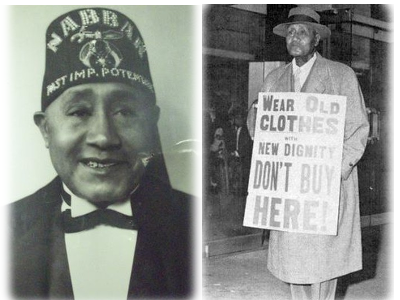
The Pollard film walks us through Jackson’s illustrious family history, the grandson on his mother’s side, of John Wesley Dobbs, an influential college educated postal employee and Prince Hall Masonic Grand Masterwho prescribed “bucks, ballots and books” as the keys to black uplift.
John Wesley Dobbs, Maynard Jackson’s maternal grandfather.
Dobbs was a key player in registering tens of thousands of black Atlanta voters in the 1940s, a time when many rural black Georgians were either illiterate or not allowed to vote. His efforts were widely credited with getting the city of Atlanta to finally put street lights on Auburn Avenue, where many black businesses were located, and to hire the first handful of black Atlanta cops, who of course were not permitted to arrest white people. It’s not in the movie, but Billy McKinney, decades later a Georgia state representative, and the father of former Atlanta congressperson Cynthia McKinney was one of those first black Atlanta cops.
Jackson’s dad was a prominent black Atlanta pastor and his mother was one of six Dobbs daughters all of whom graduated from Atlanta’s Spelman College, earning her PhD at the University of Toulouse in France. Upon her return to Atlanta she was the first black person granted a library card by the city’s public library. If there was such a thing as an African American elite, Maynard Jackson was born into it. An exceptionally smart young man, he was admitted to Morehouse at 14, graduated at 18, and bounced around a little before obtaining a law degree in North Carolina. According to the movie, it seems Maynard Jackson never much considered a career doing anything else other than running for and winning elected office.
In 1968 Maynard Jackson ran for US Senate against arch-segregationistsenator Herman Talmadge, who’d inherited a political career from his daddy, three term governor Eugene Talmadge. Jackson lost, but thanks to the black vote he did carry the city of Atlanta. The following year he was elected Atlanta’s vice-mayor, and four years later at the age of 35 he became the first black mayor of Atlanta.
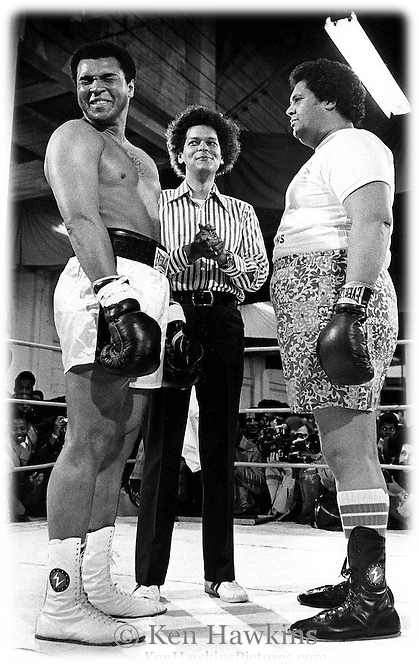
The movie dwells nostalgically upon the star studded celebration
Maynard Jackson spars with Muhammad Ali for charity.
which attended his ascension to mayoral office, and contemptuously dismisses the aspirations of the black masses who voted for Jackson and his successors, saying they somehow expected the election of black mayors to solve all their problems. Pollard spends the biggest chunk of the movie following the ins and outs of Jackson’s struggles, in his three terms as mayor, with Atlanta’s white elite to put black faces on the boards of banks and planning bodies, and his adamant insistence that black companies be cut a fair share of city contracts and professional services. It’s quite clear that for the film makers, for Jackson’s contemporaries who they interviewed, and for Maynard Jackson himself, that the project of diversifying and opening up the capitalist elite was then and remains today the main objective of black politics, not the struggles of ordinary people for jobs, decent wages, housing, health care, education, justice and peace.
The movie goes so far as to portray the effort of Maynard Jackson and former mayor Andrew Young in which they shamelessly invoked the ghost of Dr. Martin Luther King to bring the 1996 Olympics to Atlanta as some kind of visionary achievement that really put the city on the map, whatever that term means. In real life, as lived by most residents of cities which “win” the right to host the Olympic Games, the prize consists of an orgy of predatory real estate speculation in which entire low to moderate income neighborhoods are demolished to make way for stadiums, luxury hotel and tourist destinations, for upscale shopping and residential development, all of it lavishly subsidized with tax dollars taken from property taxes and wages of the poor, not from the wealth of the rich. Atlanta was no exception to this rule. Neighborhoods surrounding the Olympic sacrifice zone experienced precipitous increases in real estate taxes and rents to levels which Atlanta residents who were there before the Olympics could not sustain. The lion’s share of the displaced Atlanta homeowners and renters were of course black. But their struggles, their politics have no place in the self-serving histories written by the black elite, so the movie just doesn’t see them.
This political biography ignores the political struggles of ordinary Atlanta residents for decent housing, wages and working conditions, when they could get a job at all. It never mentions the decades long fights for universally accessible health care which resulted for a time, in a well funded health care system in Atlanta’s Fulton and Dekalb counties – the Grady Hospital system, parts of which endure to this day.
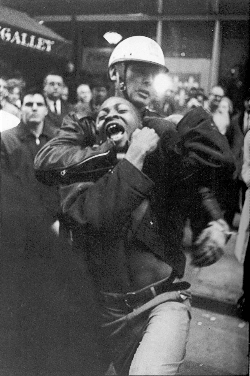
Atlanta cops brutally assault striking
sanitation workers during 1977 strike,
Tellingly, it omits Maynard Jackson’s decisive and shameful interventionin the 1977 strike of Atlanta’s heinously abused and underpaid black sanitation workers, in which the first black mayor hired scabs and mobilized SCLC, black pastors and civil rights leaders against self-organizing black workers standing up for their human rights.
The only person the film makers interviewed who wasn’t a family member, a successor, aide or associate of the late mayor or reverends named Al Sharpton or Jesse Jackson was a relative of one of the victims of Atlanta’s child murdersduring Jackson’s final term as mayor. To hear them tell it, that and the insurrection following the Rodney King verdict, and Jackson’s failure, typical of every other deeply change the institution of policing beyond hiring and promoting more black officers, were the only real failures of Jackson’s career.
Sam Pollard’s kind of political history with most of the politics removed is the rancid foundational myth for the long running hoax of Atlanta as North America’s Black Mecca. Fact is, Black Mecca was never anything other than the self-promoting, self-serving and self-celebrating PR campaign of black elites. As I wrote back in 2005,
“Today’s elite black leadership does not measure cities by their incarceration rates, nor do they measure their own performance by the prevalence or absence of child poverty, affordable health care, equality of access to good education or any of the things that matter to ordinary black families. What matters to these “black leaders” are big-ticket projects, bragging rights, relentless self-promotion, and the accumulation of contacts, contracts and personal wealth. “Black Mecca” was always intended to be where their dreams came true, not ours.”
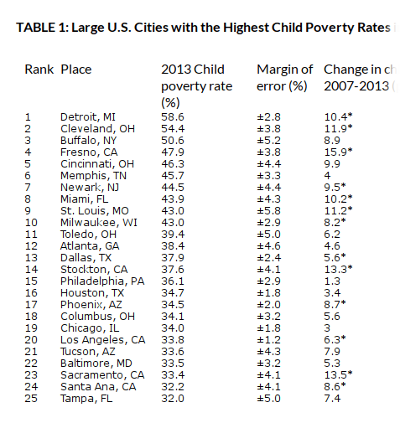
For a generation now, Atlanta has been among the top four or five US cities for black millionaires. But 2013 census data plainly reveal that among the 71 US cities with populations over a quarter million
Atlanta, the supposed “Black Mecca” ranks 12th in child
poverty, better than Newark, Memphis or St Louis,
but worse than Chicago, Los Angeles, Philly or
Houston, according to US census data.
The accepted wisdom ignores these things, and the Sam Pollard documentary lazily slides right into that established groove. The film does get a couple of important things right. Jackson’s enduring political legacy was the cynical hoax of Atlanta as Black Mecca, and his career, which relied on the votes of black masses whose votes were mobilized behind the first black mayor who they imagined would deliver for their class instead of his own foretold the career arc of the first black president early in the 21st century.
I’d give the thing two and a half stars out of five.
For Black Agenda Radio, I’m Bruce Dixon. Please note that Google has limited public access to Black Agenda Report, suppressing the appearance of our material in search results for almost 3 years now, after the Washington Post endorsed a specious claim that we were somehow under the influence of the Russians. We are the first and as far as we know the only black owned and operated outfit to enjoy this distinction. Facebook’s recent partnership with the Atlantic Council puts deep state intelligence and propaganda operatives in charge of what you can and cannot see on Facebook as well. So the only way you can be certain you’re getting fresh news, commentary and analysis from the black left is to visit us at www.blackagendareport.com and hit the SUBSCRIBE button, so you’ll receive links to all our newly published print and audio content in your email inbox each and every week, free from the interference of the corporations which otherwise run the internet.
The marketers call email “dark social media” because they cannot suppress, control, censor or track it. You can also find our audio podcasts – not our printed articles but our our weekly one hour Black Agenda Radio at iTunes, Stitcher and wherever else you get your podcasts, along with shorter Black Agenda Radio Commentaries like this one. If you catch us on iTunes or wherever you get podcasts be sure and leave us a glowing review, because that’s how other people discover us.
We invite readers and listeners to respond to and comment on our articles and podcasts on Black Agenda Report’s Facebook page, or via email at comments@blackagendareport.com, that’s comments@blackagendareport.com. Some of the comments will appear and be answered in our new weekly letters column.
Bruce A. Dixon is managing editor at Black Agenda Report, and a member of the state committee of the GA Green Party. He livesw and works near Marietta GA and can be reached via email at bruce.dixon(at)blackagendareport.com.
 Claudia Ellquist, a delegate to the National Committee and two time Green Party candidate for County Attorney in Pima County Arizona, died Sunday, November 18th, 2018 at the age of 70. Party activists were alerted by a forwarded email from her husband of twenty-four years, John Yoakum.
 2020 is a Presidential Election year, and the Georgia Green Party will have the opportunity to nominate 16 candidates for the Electoral College. But to do so it must deliver 54,431 valid signatures. Signature collection can begin on April 15th 2019, three and a half months from now.